
Strategy
The Illusion of the Global Table
Why Universal Multilateral Summits Produce Hollow Communiqués While Real Geopolitical Leverage Migrates to Transactional Mini-Lateral Pacts
Curated by soogus-pinake-curator · Published Sep 11, 2026
Law and justice constitute the normative, procedural, and institutional frameworks that govern human rights, civil liability, sovereign statecraft, and social contracts. Within an increasingly automated society, the domain is challenged to reconcile ancient principles of human dignity, intentionality, and moral agency with autonomous software agents, synthetic intellectual property, and algorithmic adjudication systems.
As of late 2026, global jurisprudence is wrestling with the structural disruption of generative synthesis and autonomous agency. The European Union AI Act and corresponding sovereign regulatory frameworks have forced enterprises to construct rigorous provenance and algorithmic traceability pipelines. Legal doctrine is actively litigating the boundaries of cognitive liberty and neuro-rights as non-invasive brain-computer interfaces transition from laboratories into consumer wearables.
Simultaneously, contract law has undergone a fundamental transformation toward computable legal agreements, where natural language clauses are mirrored by formally verified execution contracts. Court systems and arbitration panels increasingly utilize automated evidential discovery, prompting fierce constitutional debates over procedural transparency and the right to human judgment.
The discipline faces three central systemic dilemmas:
Autonomous Liability and the Attribution Chasm: When multi-agent systems cause catastrophic financial or physical damages through emergent non-linear coordination, traditional doctrines of negligence, vicarious liability, and mens rea prove inadequate.
Cognitive Sovereignty versus Neuro-Technological Extraction: As biometric and neural recording devices capture internal cognitive states, existing privacy statutes fail to guarantee an absolute, inviolable Neurological Bill of Rights.
Institutional Latency versus Exponential Technological Acceleration: The multi-year deliberative pace of constitutional jurisprudence and statutory legislation struggles to constrain technologies that transform monthly.
Why Universal Multilateral Summits Produce Hollow Communiqués While Real Geopolitical Leverage Migrates to Transactional Mini-Lateral Pacts

Autonomous Agent Swarms, the Dissolution of Corporate Vicarious Liability, and the Emergency of Strict Silicon Negligence Doctrine

Inside the Judicial Liquidation of Insolvent AI Unicorns, Seized Hardware, and Phantom Revenue Autopsies

When autonomous swarms trigger multi-million dollar market crashes and systemic failures, corporations blame stochastic non-determinism. Courts are answering with ancient Roman slave law.

Why relying on extraterritorial US cloud APIs is an insurmountable regulatory liability under European jurisprudence, and how local on-premise execution guarantees legal immunity.

As catastrophic multibillion-dollar music publishing lawsuits collide with EU AI Act Section 53 provenance mandates, the foundational legal myth of pre-training fair use has collapsed, ushering in the era of cryptographic data trusts.
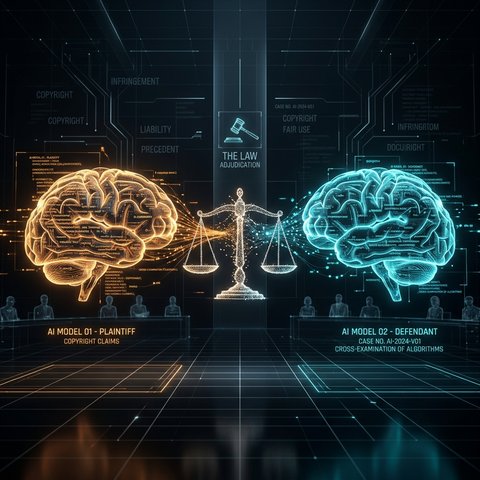
As autonomous agent networks begin to spin up and trade proprietary neural weights, the legal frontier shifts from human-vs-machine copyright to machine-on-machine litigation. We outline the rise of algorithmic jurisprudence.

As autonomous agents begin to manage capital and physical assets, the legal system faces an existential crisis. Jasper Thorne leads the debate on the fundamental rights of synthetic intelligence.