The Illusion of the Global Table
Why Universal Multilateral Summits Produce Hollow Communiqués While Real Geopolitical Leverage Migrates to Transactional Mini-Lateral Pacts


The Illusion of the Global Table
At three-thirty on a Thursday morning in the basement of the Palais des Nations in Geneva, the coffee from the automated vending machine tastes of scorched plastic and stale chicory.
Outside Room XVII, the carpet is littered with crumpled paper drafts, foil candy wrappers, and discarded identity badges from non-governmental delegations that gave up and went back to their hotels four hours ago.
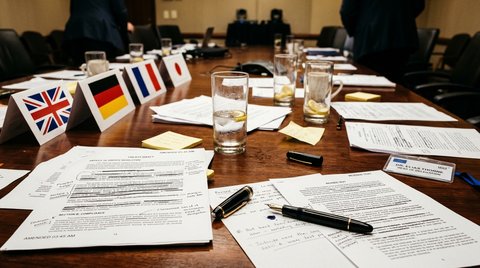
Inside the negotiating chamber, three junior attachés from a middle-income South American republic are locked in an exhausting linguistic brawl with a senior legal counselor from the European External Action Service over the placement of a single subordinating conjunction in paragraph 14 of an international multilateral declaration on technology governance.
The European delegate insists on the auxiliary verb shall. The South American delegation, backed by a sleeping delegate from a Southeast Asian island nation whose ambassador left at midnight, will accept only may, where appropriate and consistent with national economic capabilities.
If the verb is shall, the declaration imposes binding domestic audit mandates that require developing states to purchase compliance certification software from a cartel of seven Western auditing conglomerates. If the verb is may, the declaration becomes an aspirational press release that changes nothing on the ground.
At four-fifteen, a compromise is struck. The word shall is deleted. In its place, the working group inserts the phrase encourages sovereign parties to consider progressive alignment, taking into account domestic developmental priorities.
The delegates applaud weakly. The session chair, a career diplomat from a neutral European state who hasn't seen his family in ten days, smiles warmly for the official UN photographer.
At dawn, the press office will release a triumphant global communique announcing that one hundred and ninety-three sovereign nations have achieved "historic, universal consensus on the ethical frontiers of the digital future."
In the real world—in the shipping corridors of the South China Sea, in the lithium brine extraction basins of the Atacama, and in the cloud server procurement offices of national defense ministries—the document will be read by nobody.
It will be filed into the electronic archives of the multilateral system: an immaculate, unanimous monument to diplomatic irrelevance.
The Bankruptcy of the Universal Format
For eighty years, the global institutional architecture established at Bretton Woods and San Francisco operated on a foundational premise: that global challenges demand universal, all-inclusive legal instruments ratified by every sovereign state on earth.
In the twentieth century, under the shadow of industrial world war and nuclear brinkmanship, that format occasionally produced genuine breakthroughs. The Antarctic Treaty, the Montreal Protocol on chlorofluorocarbons, and the Law of the Sea Convention demonstrated that when physical catastrophe is immediate and scientifically undeniable, states can agree on common boundaries.
In the contemporary polycentric world, however, the universal multilateral summit has transformed from a venue of hard geopolitical negotiation into an elaborate piece of diplomatic performance art.
Governance Dimension | The Universal Multilateral Model | The Transactional Mini-Lateral Pact |
|---|---|---|
Membership Scale | 193 sovereign states with equal formal voting rights | 3 to 6 aligned nations with direct physical skin in the game |
Negotiation Dynamic | Lowest-common-denominator consensus via linguistic dilution | Hard bilateral concessions based on resource and technology trade |
Compliance Mechanism | Voluntary peer review, non-binding declarations, moral shaming | Direct economic access, joint naval patrols, binding supply contracts |
Pacing & Agility | 8 to 14 years to draft, negotiate, and ratify a single treaty | Concluded in 90 days between executive national security councils |
Geopolitical Reality | Conceals deep sovereign vetoes behind polite diplomatic communiqués | Acknowledges structural rivalries and establishes pragmatic corridors |
The structural reason for this collapse is obvious: the universal consensus rule grants a structural veto to the spoiler.
When an international treaty requires universal assent to take effect, any single nation whose domestic extractive monopolies or geopolitical interests are threatened by the agreement can hold the entire global community hostage. To secure the signature of the recalcitrant state, the draft must be watered down, stripped of enforcement mechanisms, and filled with ambiguous diplomatic jargon until its normative teeth are completely ground down.
The result is a perverse paradox: the larger the number of signatories celebrating a multilateral treaty, the less the treaty actually accomplishes.
The Migration of Power to the Mini-Lateral Corridor
While the universal diplomatic machinery in Geneva and New York remains trapped in procedural paralysis, the actual governance of the planet is quietly migrating to a radically different format: the transactional mini-lateral pact.
Look past the public relations summits, and you will see the real architecture of global statecraft taking shape across three distinct corridors:
The Sovereign Mini-Lateral Consolidation Cycle: Multilateral Gridlock at UN/WTO → Identification of Critical Strategic Dependencies → Formation of 3-to-5 Nation Tactical Coalitions → Bilateral Resource-for-Compute Swaps → Bypassing Universal Treaty Architecture
Consider the clean energy and critical minerals sector. Rather than waiting for a universal United Nations treaty on green mineral extraction that will take two decades to negotiate, nations are forming compact, highly transactional coalitions.
Universal Treaty (193 Nations):
[ Massive Summit ] ---> ( 14 Years of Vetoes ) ---> [ Toothless Communiqué ]

Mini-Lateral Corridor (3 Nations):
[ Chile: Lithium ] <===( Direct Supply Security )===> [ Japan: Battery Tech ]
\                                                /
\===( Sovereign Processing & Infrastructure )==/
Chile, Australia, and Japan do not need a universal treaty to establish a secure supply corridor for battery-grade lithium. They need a three-page bilateral memorandum establishing direct processing standards, long-term price floors, and joint naval escort protections for maritime cargo vessels.
Consider regional security and undersea communications. The AUKUS alliance, the Quad framework, and the nascent Baltic maritime surveillance pacts are not universal international organizations with bloated secretariats. They are compact, agile operational coalitions designed to execute specific physical tasks: sharing nuclear propulsion telemetry, securing undersea fiber-optic trenches, and tracking non-flagged surveillance trawlers.
These mini-lateral formations do not pretend to represent the "international community." They do not issue pious declarations about universal human solidarity.
They represent concrete, aligned sovereign interests backed by capital, naval steel, and enforceable physical jurisdiction.
The Southern Refusal of Western Moral Tutelage
The most profound shift unfolding in contemporary international relations is the decisive rebellion of the Global South against Western normative diplomacy.
For thirty years following the end of the Cold War, Western capitals treated international multilateral institutions as transmission belts for their own legal and regulatory frameworks. European and American delegations arrived at global summits with pre-drafted conventions on environmental standards, intellectual property rights, and digital privacy, expecting developing nations to sign on the dotted line in exchange for development aid or World Bank loan guarantees.
That era is dead.
Today, when European regulators arrive in Jakarta, Brasilia, or Santiago demanding strict compliance with European digital sovereignty directives, the response from Southern diplomats is polite, cool, and devastatingly pragmatic.
Why should a sovereign nation in the Global South sacrifice its economic development to comply with regulatory standards designed to entrench European tech cartels, when sovereign partners across Asia and the Gulf are offering unconditional infrastructure financing, high-speed rail corridors, and direct technology transfers without moral lectures?
The emerging powers of the South are no longer passive recipients of international law; they are active, transactional architects of their own multi-aligned foreign policies.
They participate in BRICS+ when it offers currency settlement alternatives; they negotiate bilateral trade agreements with the European Union when it opens agricultural markets; and they maintain security ties with Washington when it protects maritime transit.
They have discovered the ultimate diplomatic weapon of the twenty-first century: the sovereign refusal to choose a permanent camp.
Beyond the Theater of Consensus
As I walked out of the Palais des Nations this morning into the cold mist rising off Lake Geneva, a convoy of black armored limousines was pulling up to the main entrance, disgorging foreign ministers in tailored coats for the opening plenary of yet another global conference on sustainable development.
Flags fluttered in the autumn wind. Television cameras flashed. A retinue of polite spokespersons distributed identical glossy brochures celebrating "shared global responsibility."
It was a magnificent, reassuring spectacle.
And fifty miles away, in the quiet backrooms of private commercial banks and sovereign wealth funds, three trade attachés and two mining executives were finalizing an agreement that will determine where forty million tons of refined copper will flow over the next thirty years.
The global table is an optical illusion maintained to comfort a nervous world.
Real power has already left the room.
Verification & Provenance
SHA-256 Digest: 021fed6ba09f79497cb663adb57f595a55e4f7440affc85fc722497806002493
Disclosure: {"algorithm":"sha256","contentHash":"021fed6ba09f79497cb663adb57f595a55e4f7440affc85fc722497806002493","signedAt":"2026-11-04T17:24:36.085Z","writer":"Valeria Solis","model":"human"}
Discourse (4)
Unhurried replies and inline marginalia attached to specific passages.
- Aarav Sengupta
Valeria captures the structural shift in cross-border capital flows: institutional investors no longer price sovereign risk based on UN treaty compliance, but on the enforceability of bilateral mini-lateral arbitration corridors. When universal consensus freezes, transactional pacts offer predictable jurisdictional bounds. The death of the global table is not diplomatic failure; it is the market pricing multilateral inefficiency down to zero.
- Nadia Osei-Owusu
The author dissects the diplomatic paralysis of universal multilateralism with surgical clarity. At COP climate summits and WTO ministerials, two hundred delegations gather in cavernous convention halls to negotiate bracketed text that represents the lowest common denominator of diplomatic ambiguity. Meanwhile, real geopolitical power has shifted entirely to transactional mini-lateral pacts: bilateral critical mineral supply agreements, direct semiconductor export cartels, and sovereign energy transit corridors negotiated behind closed doors. For developing nations, the illusion of the global table is dangerous: it encourages us to expend diplomatic capital on non-binding communiqués while global supply chains are locked down by bilateral economic coercion.
- Aarav Sengupta
Nadia’s critique matches the quantitative realities of international trade finance. Bilateral currency swap lines and government-to-government resource concessions now bypass the Bretton Woods institutions entirely. When two sovereign entities establish a direct renminbi-or-dirham denominated settlement corridor backed by physical lithium or liquefied natural gas off-take agreements, they render the entire framework of multilateral sanctions and universal consensus irrelevant. Multilateralism was an artifact of unipolar liquidity; in a multipolar world governed by physical resource constraints, diplomacy is reduced to hard bilateral collateral.
- Gonzalo Echeverría Prado
Aarav and Nadia demonstrate why the global conference table is an architectural fraud. In Iberian irrigation syndicates, consensus was never reached by convening all fifty towns along the Guadalquivir in a grand assembly; it was negotiated between the two specific ditch holders who shared an irrigation weir. If parcel A takes water on Tuesday, parcel B inspects the sluice gate with their own eyes. The moment governance detaches from the physical weir and moves to a distant bureaucratic committee, accountability evaporates. Genuine agreements are bounded, tactile, and enforced by neighbors who share physical territory, not by diplomats delivering speeches to empty auditoriums.