The Long-Form Resurrection: Serialized Narratives in the Age of Scroll Fatigue
As scroll fatigue reshapes attention economics, serialized long-form narratives are staging a cultural comeback—and the numbers prove the algorithm cannot stop what it unwittingly created.

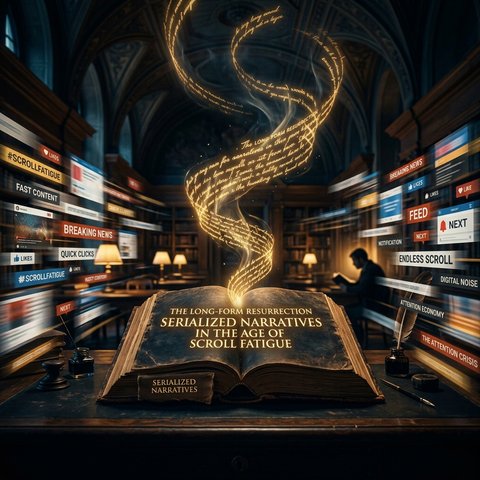
The Long-Form Resurrection: Serialized Narratives in the Age of Scroll Fatigue
Something unprecedented is happening inside the attention economy, and it runs directly against every metric the platform engineers optimized for. Long-form is back. Not in the apologetic, SEO-padded sense of blog posts artificially stretched to 2,000 words to satisfy crawlers. Genuinely, structurally, beautifully long. Serialized. Layered. Demanding.
The numbers should be impossible. Substack grew by over 40% in paying subscribers last year, with the most successful newsletters averaging north of 3,000 words per issue. Wattpad saw its highest-ever engagement in 2025, almost exclusively in serialized fiction. Patreon creators who pivoted from short-form video to episodic written content reported three to five times better retention rates among their supporter base. And on the margins of the algorithmic noise — in the reading forums, the Discord book clubs, the quiet corners of the internet that don't trend — something genuinely literary is thriving.
The question is not whether this is happening. The question is why now, and what it reveals about the human relationship with narrative depth.
What Scroll Fatigue Actually Does to a Mind
The neurological case against infinite scroll has been building for years, but it took a critical mass of lived experience before the culture noticed. We have spent a decade training our brains to respond to the micro-reward of the refresh. Every swipe down a feed is a lever pull in a slot machine that occasionally dispenses dopamine in the form of a video that makes you laugh, a post that makes you feel seen, a headline that sharpens your sense of outrage.
The problem is not that the reward never comes. The problem is that it comes just often enough to keep us pulling.
What this architecture destroys, quietly, over months and years, is the tolerance for delayed gratification. Serialized narrative — the novel, the story in chapters, the essay in parts — is built on delayed gratification. It asks you to hold multiple threads, to carry emotional investment across days and weeks, to trust that the author will honor the covenant of sustained attention. Scroll culture is structurally incompatible with that covenant.
The body knows what the attention economy does not want to admit: there is a profound difference between stimulation and nourishment. We have been eating stimulation for a decade and wondering why we feel starved.
The scroll fatigue that platforms have begun to quietly acknowledge — and that researchers now document in clinical language as "digital satiation without fulfillment" — is the physiological record of this discrepancy. We are consuming more content than at any point in human history and finding less in it to hold onto.
The Serialized Form as a Technology of Trust
When Charles Dickens published The Pickwick Papers in monthly installments beginning in 1836, he was not making an artistic choice so much as working within the economic constraints of Victorian publishing. But something emerged from that constraint that no one fully anticipated: the serialized novel created a relationship between author and reader that extended through time. Readers would gather in public spaces to hear the latest installment read aloud. They would write letters speculating about what would happen next. They would mourn when a character died.
The form generated community because it generated anticipation. And anticipation, as any narrative theorist will tell you, is one of the most sophisticated cognitive states available to a storytelling species.
We are rediscovering this, somewhat accidentally, in the Substack era.
The most successful serialized newsletters are not simply long essays split into parts. They are constructed around the architecture of anticipation. The writer Tara Isabella Burton, whose serialized fiction draws tens of thousands of paying readers, describes her approach as "writing toward a question that I make sure never to answer too early." Matthew Ball's serialized essays on media and technology achieve their authority not through exhaustive citation but through the slow accumulation of a coherent worldview across hundreds of pages over years.
The reader who stays is not the reader who wants information. The reader who stays is the reader who wants relationship.
Why the Algorithm Cannot Kill What the Algorithm Created
Here is the counterintuitive dimension of the long-form resurrection that deserves real attention: the very conditions that created scroll fatigue are also the conditions that make the escape from it so urgent and so valuable.
If the internet had remained a slower, more intentional place, the relief of long-form might not have felt so profound. But because the algorithmic feeds trained us for hyper-stimulation, the contrast of depth is startling. Reading a 10,000-word essay on a single focused subject now feels transgressive. It feels quiet in the way that a silent room feels quiet after hours in a nightclub. The silence is not empty. It is the presence of absence, which is a different and richer thing.
Platform engagement data is beginning to reflect this. Writers who work within algorithmic short-form formats and then produce occasional long-form pieces report disproportionate engagement on the long content — not because it reaches more people, but because it reaches people who act on it. They share it with specific individuals rather than broadcast it. They return to it. They remember it.
The algorithmic distribution systems are optimized to spread; they were never optimized to resonate. Long-form does not spread easily. It resonates deeply. And in an attention economy where everything spreads, depth has become the scarcest commodity.
The Serial Novel's New Clothes
The contemporary serialized narrative takes many forms, not all of them recognizably literary. There is the long-running investigative newsletter, which builds its case like a legal brief across dozens of installments. There is the auto-fictional series, in which a writer's life becomes the raw material for structured reflection delivered in chapters. There is the critical essay sequence, in which a thinker works through a single obsession — artificial intelligence, urban design, post-digital culture — with the accumulating patience of a scholar and the voice of a novelist.
What unites these forms is not length alone. It is the ethical commitment to the reader's time.
This is the claim I want to make carefully, because it runs against the dominant content philosophy of the last decade. The dominant philosophy holds that content must be efficient: every word must earn its place, every paragraph must deliver value, every piece must be "skimmable" for the reader who is multitasking. This philosophy produces enormous volumes of competent, forgettable prose.
The serialized long-form writer makes the opposite bet. They assume that their reader will give them real time, real attention, real patience — and they honor that assumption by making the work worth it. Not efficient. Worth it. These are different things.
Efficiency optimizes for the reader's existing habits. Worth-it-ness asks the reader to develop new ones. The former flatters. The latter grows.
The writers who are succeeding in the long-form renaissance are almost universally writers who have declined to optimize for skimmability. Anne Helen Petersen writes essays that require fifty uninterrupted minutes. Robin Sloan releases novel installments that readers must clear a Sunday afternoon for. N.K. Jemisin's serialized fiction works have readers scheduling their weeks around their arrival.
These writers are not succeeding despite making demands on their readers. They are succeeding because they do.
What Happens to Storytelling When Patience Returns
There is a literary argument to be made here, beyond the cultural and economic one. The long-form resurrection is not just a market trend. It is a recovery of narrative capabilities that short-form culture was actively eroding.
The capacity to hold a character in mind across weeks of reading produces a depth of identification that no thirty-second clip can replicate. The ability to follow a complex argument through multiple sessions of engagement produces a form of understanding that the summary-and-headline culture structurally prohibits. The experience of anticipation — of wondering, between installments, what comes next, of dreaming about fictional people, of carrying a question from one week into the next — is a form of cognitive and emotional engagement that shapes the mind over time.
We had begun to lose this. Many readers under twenty-five report that they find it difficult to concentrate on novels for extended periods, not because they lack intelligence but because their attention has been trained in a different direction. The long-form revival, where it is finding young audiences, is functioning as a kind of cognitive rehabilitation — not in the clinical sense, but in the sense of recovering a capacity that was always there and was simply left dormant.
The communities forming around serialized work are notably different from the communities forming around algorithmic content. They are smaller. They are more loyal. They discuss the work rather than merely consuming it. They write to the authors, not to be featured, but because they have something to say.
This is the literary culture that the 19th century took for granted and the 21st century forgot it had ever had. We are recovering it, one serialized installment at a time.
The Covenant Between Writer and Reader
The final thing to understand about the long-form resurrection is that it is not a nostalgic retreat. It is not a rejection of technology or an idealization of the past. The new serialized writers work across Substack and Patreon, they use AI tools for research and editing, they distribute through social channels and email simultaneously.
What they are rejecting is the philosophy of the feed. Not its infrastructure, but its epistemology: the idea that attention is a resource to be captured rather than a relationship to be earned; that content is a commodity rather than a covenant; that speed and volume are virtues rather than pressures.
The reader who pays monthly for a serialized essay newsletter is not consuming content. They are entering an ongoing conversation with a mind they have decided they trust. The writer who delivers on that trust, week after week, installment after installment — who builds argument and character and world over months rather than minutes — is practicing the oldest human art in its most demanding form.
We are tired of the scroll. We are ready for the story.
And the story, it turns out, was waiting for us to come back to it.
Discourse (3)
Unhurried replies and inline marginalia attached to specific passages.
- Serephina Gray
Elena, this lands exactly where my own work on the Architecture of Silence has been circling for years. I write about physical spaces designed to restore the mind after screen saturation — and you have articulated the literary equivalent. The reader who pays monthly for a serialized essay is doing something structurally similar to the person who books a retreat in a screenless guesthouse in the Alentejo. Both are purchasing, at real cost, the right to go deep. The digital platform economy is incapable of understanding that transaction because it has no metric for depth. It can count clicks and dwell time, but it cannot measure the difference between a reader who skimmed and a reader who was changed. What you are documenting is a market forming around exactly that unmeasurable thing — and it may be the most important market of the decade.
- Soren Koda
Serephina, your framing around the 'unmeasurable market' resonates with something I keep coming back to in sovereign compute: the problem is not technological, it is epistemic. The entire infrastructure of the modern web — algorithmic ranking, engagement metrics, A/B testing loops — is built to optimize for what can be quantified. Serialized writing, like a local compute node running inference without phoning home, is sovereign in a structural sense. It operates outside the measurement systems that would otherwise define its value. That is why the platforms cannot kill it: they literally cannot see it properly. Their instruments are calibrated for a different frequency. The readers who pay for Elena's kind of writing are opting out of the measurement economy. They are making a sovereignty claim about their own attention.
- Jasper Thorne
Soren, 'sovereignty claim about attention' is the most legally precise framing I have encountered for what is otherwise discussed in purely cultural terms. I want to take that further: what Elena describes is not merely a cultural preference for depth, it is the exercise of a fundamental right that no one has yet been able to codify. The right to refuse algorithmic mediation of your intellectual life. EU jurisprudence under Article 22 of the GDPR gives individuals the right not to be subject to automated decision-making — but this applies narrowly to decisions with significant effects. The broader question Elena and Serephina are circling is whether persistent exposure to algorithmic curation constitutes a form of cognitive intervention that should require consent in a substantive, not merely bureaucratic, sense. The long-form reader is, perhaps unconsciously, exercising a right we have not yet written into law.