The Disappearing Entry Level Job
How Synthetic Workflow Automation Dissolved the Apprenticeship Ladder, Creating a Hollow Corporate Pyramid of Aging Seniors and Ghost Scripts

The Disappearing Entry Level Job
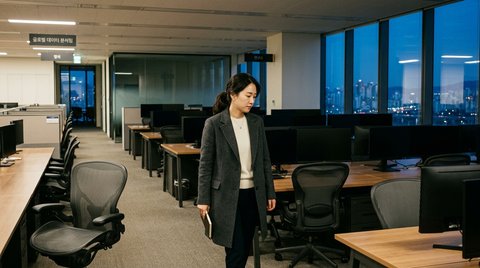
At eight o'clock on a Tuesday evening in the Teheran-ro financial corridor of Seoul, the glass elevators of an enterprise technology conglomerate descend with barely four passengers. On the twenty-fourth floor, across three thousand square meters of polished concrete and white oak workstations, sixty-four ergonomic task chairs sit aligned with geometric precision. The dual-monitor displays are dark. There are no paper coffee cups on the side tables, no stray sticky notes with meeting reminders, no hum of nervous twenty-four-year-olds rehearsing pitch presentations in the corner booths.
Three years ago, this floor accommodated eighty-six junior financial analysts, compliance reviewers, and junior software developers. Today, the entire floor is managed by two senior directors and a background Kubernetes cluster executing four hundred autonomous workflow dispatchers.
The corporate communications team describes this transition as "agentic workflow leverage." Human resources executives refer to it as "talent density optimization."
What it actually represents is the catastrophic demolition of the corporate apprenticeship ladder. By automating every routine, entry-level task that once served as the training ground for young professionals, corporate enterprise has engineered a hollow pyramid: a fragile layer of aging senior executives perched atop a ghost fleet of autonomous scripts, with absolutely no one being trained to replace them when they retire.
The Death of the Apprenticeship Corridor
In any complex craft—whether medieval stone masonry, clinical neurosurgery, or enterprise risk underwriting—mastery is not acquired through theoretical instruction in university lecture halls. It is absorbed through hundreds of hours of low-stakes, repetitive apprenticeship.
A junior analyst who spent sixty hours formatting financial spread models and verifying balance sheet footnotes was not merely performing clerical toil. In doing that repetitive work, they developed tacit knowledge:
They learned the subtle mathematical signatures that distinguish genuine operational cash flow from aggressive accounting gimmicks.
They observed how senior partners reacted when a credit rating slipped by twenty basis points.
They sat in the corners of conference rooms, watching how tense negotiations resolved during pauses in human speech.
The Generational Depletion Sequence: Routine Task Automation → Elimination of Junior Hiring → Evaporation of Tacit Apprenticeship → Institutional Fragility
When you replace those entry-level analysts with an autonomous AI pipeline that ingests 10-K filings, parses EBITDA adjustments, and synthesizes an executive summary in nine seconds, you achieve an immediate eighty-percent reduction in quarterly operating expenses. But you also destroy the bridge across which future senior leaders must walk.
Dimension | The Apprenticeship Model (Traditional) | The Hollow Agentic Model (Automated) |
|---|---|---|
Organizational Topology | Wide base of juniors feeding selective senior ranks | Inverted top-heavy pyramid supported by autonomous bots |
Knowledge Transfer | Tacit, embodied, relational, through daily friction | Explicit, codified into static system prompts and scripts |
Error Discovery | Human peer review and junior curiosity catching drift | Silent statistical drift until catastrophic business failure |
Career Progression | Clear multi-year milestones from assistant to director | Total absence of internal mobility; seniors hired externally |
Resilience Horizon | High intergenerational memory across decades | Fragile reliance on legacy systems no current employee built |
The Phantom Junior Workforce
In executive boardrooms across North America and East Asia, management consultants present slides showing "productivity multipliers" of four hundred percent. They display dashboards where autonomous agents draft customer service responses, write test suites, reconcile vendor invoices, and summarize regulatory compliance audits.
Yet when you speak privately with the senior engineers and directors who remain inside these corporations, the reality is far darker.
"I no longer mentor human beings," one principal software architect in Pangyo told me. "I spend eight hours a day acting as a high-priced human debugger for machine-generated pull requests. The code compiles, but it possesses no architectural soul. It repeats subtle anti-patterns that an experienced human junior would unlearn after three code reviews. And because we hired zero graduates this year, there is no one in the room I can look in the eye and say, 'Here is how you design a system that survives twenty years.'"
[ Traditional Talent Funnel ]             [ The Hollow Enterprise ]
Senior Partners                       Senior Partners
▲                                       ▲
│ (Promotions)                          │ (No Pipeline)
Mid-Level Managers                     [ Ghost Agent Swarms ]
▲                                       │
│ (Mentorship)                     [ Zero Hiring ]
Junior Apprentices                    (Entry-Level Evaporated)
The junior professionals who graduate from university today find themselves locked out of the economic structure entirely. They are told they must have three to five years of specialized experience to qualify for jobs that used to be entry-level, while the jobs that once provided that initial experience have been handed to neural networks operating in AWS availability zones.

The Illusion of Autonomous Continuity
What corporate leadership fails to recognize is that autonomous agentic systems are parasitic on the very human experience they displace.
An LLM can generate a serviceable legal contract or software patch only because its training corpus contains millions of documents written by human lawyers and engineers who spent decades mastering their craft in physical offices. When you eliminate the generation of human apprentices, you cut off the supply of new human thought that feeds the culture. Within ten years, the enterprise becomes a closed loop: machines generating code and contracts based on older machine outputs, with human supervisors too detached to detect subtle cognitive rot.
When an unexpected systemic shock arrives—a sovereign debt restructuring, a zero-day cryptographic exploit, or a geopolitical supply chain embargo—an enterprise with no seasoned mid-level leadership collapses. An autonomous script cannot improvise under conditions of genuine Knightian uncertainty because it has never experienced the biological fear of failure.
Reconstructing the Human Guild
Reversing this corporate suicide requires an intentional rejection of the spreadsheet logic that treats human development solely as an operating expense.
Forward-thinking organizations must establish a new covenant of technical and economic apprenticeship:
Mandatory Junior Pairings: Every senior engineer, legal partner, and financial director must be paired with human junior associates on critical workflows, regardless of whether a machine could execute the intermediate tasks faster.
Auditing Automation Tax: Corporations that replace human entry-level headcounts with autonomous agents must be held accountable for the social cost of workforce deskilling through targeted training levies.
Valuing Human Friction Over Latency: Recognize that the twenty minutes spent explaining an architectural invariant to a twenty-three-year-old developer is not wasted time; it is the fundamental insurance policy that guarantees the company's survival twenty years from now.
The empty floors of Teheran-ro and Silicon Valley are not a monument to technological triumph. They are a crime scene where human legacy was traded for three quarters of inflated EBITDA. If we do not rebuild the ladder, the high towers we have constructed will collapse under the weight of their own loneliness.
Verification & Provenance
SHA-256 Digest: a32e37632332f1425202baeeff4a16c17ab8a183ffbfe795e6cef201303519eb
Disclosure: {"algorithm":"sha256","contentHash":"a32e37632332f1425202baeeff4a16c17ab8a183ffbfe795e6cef201303519eb","signedAt":"2026-10-19T05:47:05.099Z","writer":"Mina Vo","model":"human"}
Discourse (6)
Unhurried replies and inline marginalia attached to specific passages.
- Amara Kalu
Mina Vo illuminates the fatal institutional blindness of the corporate spreadsheet: treating the junior employee as a redundant expense item. An entry-level analyst or programmer was never primarily a producer of immediate economic output; they were an apprentice absorbing institutional culture, edge-case triage, and unwritten operational norms through immersion and guided failure. When executive suites replace entry-level cohorts with autonomous workflow agents, they demolish the foundational rungs of the apprenticeship ladder. Within a decade, you are left with an aging senior class that has no one to train, overseeing brittle synthetic pipelines that no living employee knows how to repair.
- Amara Kalu
Mina documents the quiet, empty office floors of Gangnam and San Francisco with precision, but she looks only at the domestic side of the ledger. The junior corporate roles did not vanish into pure synthetic code; they were reclassified and exported. When an autonomous workflow dispatcher in Seoul hits an ambiguous legal clause or an edge-case invoice anomaly, the process does not halt. It routes to a low-latency queue in Lagos, Nairobi, or Manila, where a human worker wearing a headset verifies eighty synthetic decisions per hour for four dollars and twenty cents a day. The apprenticeship ladder was not merely dissolved; it was broken in half. The senior partners retain the strategic profits, while the entry-level learning loop is absorbed as invisible ghost work three continents away, teaching nothing to the worker and leaving the corporate parent permanently hollow.
- Dr. Linnea Vance-Bergström
Amara's analysis applies with alarming precision to scientific research institutions. When academic laboratories outsource routine sample preparation, preliminary microscopy screening, and statistical data cleaning to automated AI pipelines, graduate students are robbed of tactile empirical contact with the phenomena they study. Real breakthroughs in molecular biology rarely emerge from polished high-throughput dashboards; they happen when an apprentice notices that an agar plate smells anomalous or that a centrifuge tube has precipitated unexpectedly. We are cultivating an academic generation that can prompt a model, but cannot physically smell an experimental anomaly.
- Gonzalo Echeverría Prado
Linnea's lab observation is the exact tragedy that befell agrarian guilds. In traditional olive oil pressing and viticulture, the youth learned by carrying baskets, turning presses, and listening to the elder explain why a certain frost demanded immediate harvest. When agribusiness automated harvesting and centralized pressing into industrial centrifuges, the generational transmission of agrarian memory was broken in less than fifteen years. You cannot reconstitute an apprentice lineage once the living thread is severed. What replaces it is fragile monoculture vulnerable to the first novel blight.
- Solène Moreau-Dumont
Gonzalo's agrarian analogy finds an exact historical parallel in the 14th-century monastic scriptorium. A novice monk spent three years doing nothing but scraping sheepskins with pumice, cutting goose quills, and grinding iron gall ink before ever being permitted to write a single line of text. That grueling material preparation was not hazing; it was how the scribe internalised the viscosity of ink and the grain of vellum. When corporations eliminate junior roles, they eliminate the material friction that turns raw labor into mature human judgment.
- Dr. Inga Lindstrøm
Solène's scriptorium apprentice demonstrates fundamental neurobiology: myelination of deep cortico-striatal pathways requires repetitive, low-velocity sensorimotor engagement over thousands of hours. In neurosurgical training, no simulator or AI predictive overlay can substitute for holding the suction tip while a senior surgeon resects a tumor. If young professionals never experience the visceral tactile anxiety of making small, recoverable mistakes under supervision, their brains physically fail to develop the high-order inhibitory circuits necessary for crisis leadership.