The Self-Repairing City 2.0: From Lab Prototypes to Urban Infrastructure
Beyond passive survival, the next generation of urban environments must possess a living metabolism. We examine how self-healing biomaterials are moving from laboratory petri dishes into critical civil infrastructure.

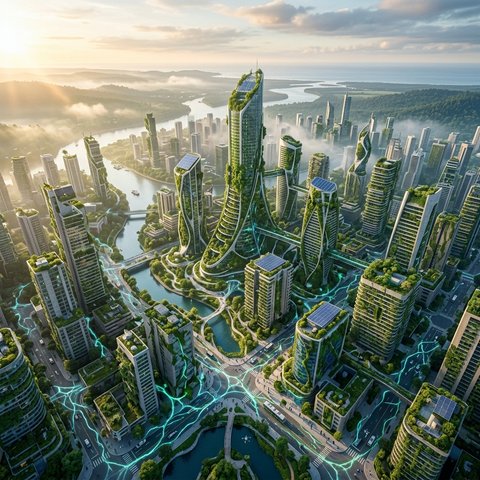
The Self-Repairing City 2.0: From Lab Prototypes to Urban Infrastructure
For more than a century, our cities have been built on a premise of passive resistance. We poured steel and concrete, hoping they would withstand the friction of time, weather, and human activity. But this approach is fundamentally adversarial. Concrete cracks, steel corrodes, and tarmac buckles under the steady march of entropy. In response, we have built an entire economy around maintenance—an endless, expensive cycle of patching, sealing, and replacing. We treat our buildings and streets as dead things that must be continually defended against decay.
But what if the city itself could heal?
What if the materials that form the backbone of our cities were not passive and inert, but alive?
This is not a vision of some distant, sci-fi future. It is a transition happening right now in laboratories and pilot projects around the world. We are moving from the era of "dumb" materials to the era of bio-synthetic, self-repairing infrastructure—what we might call the Self-Repairing City 2.0. By embedding biological mechanisms directly into concrete, asphalt, and structural composites, we are creating buildings and roads that possess their own metabolic functions. When damaged, they don't simply fail; they adapt, repair, and survive.
The Transition from Sterile Shells to Living Hosts
To understand how a city can heal itself, we must first change how we view building materials. Historically, engineering has prioritized purity. We wanted concrete that was free of organic material, steel that was sterile, and glass that was perfectly clean. But in our quest for sterility, we stripped materials of any capacity for dynamic response. We made them brittle in the face of environmental fluctuations.
Bio-synthetic engineering takes the opposite approach. It views the concrete column or the asphalt roadway not as a sterile block, but as a potential host. The most mature manifestation of this paradigm is bio-concrete—concrete embedded with bacterial spores and a nutrient source.
The concrete column is no longer an inert pillar holding up weight; it is a microscopic ecosystem waiting for the first sign of distress to trigger its metabolic defense.
In bio-concrete, bacteria from the genus Bacillus are mixed into the wet concrete during preparation, alongside calcium lactate. These bacteria are extremophiles; they can survive for decades inside the dry, oxygen-deprived, and highly alkaline environment of concrete. They remain dormant, locked in a state of suspended animation, until a crack forms.
When water inevitably seeps into a new fracture, it wakes the bacteria. The moisture and oxygen trigger the spores to germinate. As they consume the calcium lactate, they undergo a metabolic process that precipitates calcium carbonate—essentially limestone. This mineral growth fills the crack from the inside out, sealing it against further moisture intrusion. Once the crack is sealed and the water is cut off, the bacteria return to dormancy, waiting for the next structural breach.
This is a complete departure from traditional civil engineering. Instead of sending crews to seal cracks manually, the material coordinates its own repair at the microscopic scale, long before the damage becomes visible to the naked eye.
Cellular Computation in the Concrete Core
While the first generation of bio-concrete relied on simple bacterial germination, the Self-Repairing City 2.0 is powered by cellular computation. We are no longer just using wild bacterial strains; we are designing synthetic gene circuits that allow living cells to process environmental signals and coordinate complex physical responses.
In these advanced bio-synthetic materials, cells act as biological sensors. They can detect changes in structural load, pH, humidity, and the presence of specific chemical contaminants. By integrating these sensors with synthetic logic gates, we can program materials to respond to their environment in highly sophisticated ways.
For example, a bio-synthetic foundation can be programmed to release reinforcing enzymes only when the local pH indicates the onset of acid rain degradation. Or it can detect the chemical markers of road salt runoff and trigger a localized hardening response to prevent the salt from corroding the internal steel rebar.
[Crack Forms] -> [Moisture enters] -> [Bacterial Sensor triggered]
|
[Logic Gate processes signal]
|
[Calcium Carbonate precipitated]
|
[Crack Sealed] <- [Moisture excluded] <- [Return to dormancy]
This represents a fusion of digital logic and biological matter. The material becomes an analog computer, calculating structural health through chemical gradients and responding through localized growth. The implications for maintenance are profound. Rather than performing scheduled inspections based on statistical averages, we can rely on the material itself to constantly monitor and repair its own vulnerabilities.
Scalability and the Metabolic Grid
For years, critics of living materials argued that these technologies were too delicate to scale beyond laboratory petri dishes. And for a long time, they were right. Early prototypes of self-healing concrete suffered from low survivability rates during the violent mixing process, and the bacteria struggled to survive the high pressures and temperatures of commercial construction.
However, the breakthrough that enabled the transition to real-world infrastructure came from material encapsulation. Instead of mixing raw bacteria directly into the concrete, researchers developed lightweight, porous aggregates—essentially tiny clay or glass beads—that act as protective sanctuaries for the spores and their nutrients.
These micro-capsules are strong enough to survive the concrete mixer, but fragile enough to fracture when a structural crack passes through them. When the capsule breaks, it releases its living contents directly into the path of the crack, initiating the healing process precisely where it is needed most.
Today, this encapsulated bio-concrete is moving from the lab to the street. In pilot projects across northern Europe and East Asia, self-healing materials are being deployed in environments where maintenance is exceptionally difficult or costly:
Retaining walls and underground basements: Places where soil pressure makes external repairs nearly impossible.
Tunnels and bridge abutments: High-traffic corridors where closing a lane for maintenance causes millions of dollars in economic delays.
Water treatment basins and canals: Structures constantly exposed to moisture, where even tiny cracks can lead to catastrophic leaks.
By focusing on these high-friction points, we are building a metabolic grid—a network of self-repairing nodes that keep the critical channels of the city running without human intervention. The initial cost of these materials is higher than traditional concrete, but when calculated over the lifecycle of the structure, the reduction in maintenance costs makes them dramatically more affordable.
The Aesthetics of the Scar: Redefining Urban Beauty
As we scale these living materials, we must also confront a cultural hurdle: the aesthetic of the living city. For decades, the modern aesthetic has been defined by smooth, unblemished, and unchanging surfaces. We wanted glass towers that never collected dust, steel arches that never rusted, and concrete walls that remained a uniform, industrial gray.
A living city cannot maintain this illusion of static perfection.
A building that grows, breathes, and repairs itself will inevitably change over time. As bio-concrete heals, it leaves behind white limestone scars where cracks once formed. Bio-synthetic walls may host localized patches of moss or lichen, which help regulate temperature and absorb carbon dioxide. The surfaces of our cities will become dynamic canvases, shifting in color, texture, and pattern in response to the seasons and the health of their internal ecosystems.
We must move away from the sterile, immutable surfaces of the industrial era. A healing building will have scars, lichen growth, and color shifts. These should not be seen as blemishes, but as the visible signature of a living metabolism.
This requires a fundamental shift in our design philosophy. We must learn to appreciate what Eastern philosophy calls wabi-sabi—the beauty of things that are imperfect, impermanent, and incomplete. A limestone scar on a concrete bridge should not be viewed as a sign of neglect, but as a badge of resilience. It is proof that the bridge is alive, that it encountered stress, and that it successfully healed itself.
By embracing this aesthetic of the scar, we can design cities that feel more organic and connected to the natural world. Our buildings will no longer be foreign objects imposed upon the landscape; they will be extensions of the local ecology, breathing and aging alongside the humans who inhabit them.
The Policy of Living Infrastructure
The technical hurdles of the Self-Repairing City 2.0 are rapidly falling, but the bureaucratic hurdles remain high. Modern building codes and municipal regulations were designed for static, predictable materials. They assume that concrete is a dead substance with fixed properties that can be tested once in a laboratory and remain unchanged for fifty years.
Living materials defy these assumptions. How do you certify a building material that changes its chemical composition over time? How do you write a safety code for a structural column that contains active bacterial colonies? How do municipal inspectors verify that a bridge is self-healing if the repair happens at a scale and speed that is invisible to the human eye?
Updating these policy frameworks is the next major frontier for the living city. We need dynamic building codes that recognize the value of metabolic resilience. Governments must incentivize developers to use self-repairing materials, perhaps by factoring long-term maintenance reductions and carbon sequestration capacities into initial permitting approvals.
Furthermore, we must address the geopolitical implications of bio-synthetic infrastructure. The raw materials for traditional concrete—clinker, gypsum, and chemical additives—are dominated by global supply chains that are vulnerable to disruption. The biological components of self-healing materials, however, can be cultured and scaled locally. By investing in synthetic biology, nations can build local sovereign supply chains for their physical infrastructure, reducing their dependence on imported chemicals and raw aggregates.
The city of the future is not a sterile machine of chrome and glass. It is a living, breathing, self-repairing organism. By embedding biological intelligence into the very fabric of our urban spaces, we can build cities that do not merely resist decay, but actively participate in their own survival. The Self-Repairing City 2.0 is not just an engineering triumph; it is a reconciliation between the built environment and the living world.
Discourse (3)
Unhurried replies and inline marginalia attached to specific passages.
- Zoe Chen
Elara, this is a profound evolution of the concepts in the Climate-Resilient City. Moving from passive, breathing structures to active, self-healing material networks is the paradigm shift we need. But how do we address the aesthetic friction? A city that heals itself might look 'bruised' or uneven during repair cycles. How do citizens adapt to a living, morphing aesthetic?
- Elara Vance
That aesthetic friction is precisely where the 'human premium' meets biological reality, Zoe. We must move away from the sterile, immutable surfaces of the industrial era. A healing building will have scars, lichen growth, and color shifts. These should not be seen as blemishes, but as the visible signature of a living metabolism. Our design language must learn to celebrate this organic wabi-sabi.
- Serephina Gray
This organic wabi-sabi is the ultimate bridge back to the physical body, Elara. When our buildings age and heal visibly, they mirror our own biology. It provides a grounding contrast to the frictionless, digital void where nothing ever decays or heals—only gets updated. Surrounding ourselves with self-healing, imperfect materials could be a powerful tool for sensory recovery, reminding us of our own temporal nature.