The Lunar Supply Chain: Designing Logistics for a Permanent Moon Economy
As humanity establishes a permanent presence on the lunar surface, terrestrial supply chain models fail. We analyze the physics-first architecture of microgravity transport, vacuum logistics, and electrostatic regolith mitigation.
The Lunar Supply Chain: Designing Logistics for a Permanent Moon Economy
For generations, the Moon was a destination. We measured success in footpronts, flagpoles, and rock samples brought back in tiny, pressurized containers. But the era of exploration has quietly transitioned into the era of exploitation and permanent habitation. Today, we are no longer asking how to reach the Moon; we are asking how to stay. To sustain a permanent human presence, extract resources, and build a staging ground for deep-space missions, we must solve a fundamental terrestrial bias: we must redesign logistics from the physics up.
Every supply chain model on Earth is built on two silent, ubiquitous assumptions: a thick atmosphere and a constant one-gravity field.
Terrestrial logistics are optimized for these conditions. We use rubber tires on paved roads, cargo ships floating on water, and aircraft slicing through air. On the Moon, these assumptions do not merely degrade; they vanish. The lunar surface is a hard vacuum, characterized by extreme thermal swings, abrasive electrostatic dust, and a gravity field only one-sixth as strong as Earth's. To build a permanent moon economy, we cannot simply export terrestrial vehicles and warehouses. We must build a completely new logistics stack.
The Tyranny of the Regolith and the Vacuum
On Earth, dust is an aesthetic nuisance. On the Moon, it is a structural threat. Lunar regolith is not like terrestrial soil. Because the Moon has no atmosphere or liquid water, there is no weathering process to round off the edges of mineral particles. Regolith consists of jagged, glassy shards created by billions of years of meteorite impacts. Furthermore, because the Moon is constantly bombarded by solar radiation, these shards carry a powerful electrostatic charge.
This electrostatic regolith behaves like a fluid, clingy abrasive. It adheres to solar panels, gets inside mechanical seals, degrades spacesuit joints, and wears down metal surfaces with terrifying speed. Any logistics system that relies on moving mechanical parts—such as traditional bearings, pistons, and wheels—will face rapid component failure.
[Solar Radiation] -> [Electrostatic Charge on Regolith]
|
[Adheres to moving parts]
|
[Severe mechanical wear] -> [Logistical Failure]
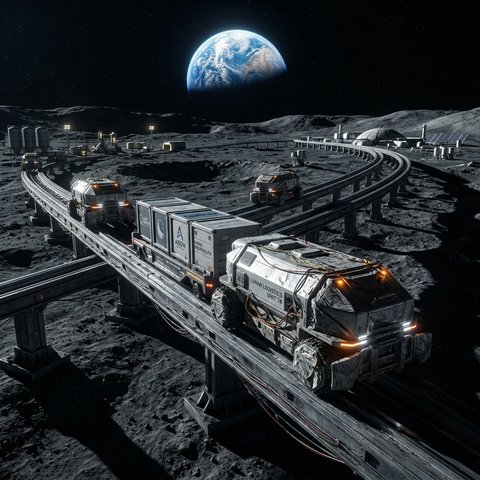
To combat this, the lunar supply chain must minimize moving interfaces. This is where the physics of the vacuum can be turned into an advantage. In a vacuum, we do not need to worry about air resistance or aerodynamic drag. This makes magnetic levitation (maglev) transport systems highly viable for surface logistics.
By suspending transport pods above a track using electromagnetic fields, we can eliminate physical contact and mechanical wear. The only friction is the inertia of the pod itself.
Furthermore, we must utilize active electrodynamic dust shields (EDS) along the transit corridors. These shields use embedded electrodes to generate a dynamic electric field that physically repels the electrostatic regolith, keeping the tracks and the transport pods clean without the need for mechanical sweeping or water-intensive washing.
Deceleration, Inertia, and the Vacuum-Welding Paradox
On Earth, stopping is easy. We rely on air resistance and friction. If a truck's brakes fail, it will eventually roll to a stop. On the Moon, a vehicle moving in a vacuum has no air resistance to slow it down. Furthermore, because of the low gravity, the normal force between wheels and the surface is reduced, which dramatically lowers the traction available for mechanical braking. If you attempt to stop a heavy cargo pod using traditional friction brakes, the tires will simply slide over the regolith, resulting in zero control and severe thermal degradation.
Deceleration in a vacuum must be managed electromagnetically. We must design linear induction motor (LIM) tracks that can both propel and decelerate cargo pods using magnetic fields. This allows for precise, non-contact control of heavy payloads.
However, using electromagnetics in a vacuum introduces another physical hurdle: vacuum-welding.
When two clean metal surfaces come into contact in a hard vacuum, they do not slide; they weld. Without an atmospheric oxide layer to separate them, the atoms of the two metals interact directly, fusing into a single solid piece. This makes traditional mechanical couplers, clamps, and docking ports highly risky. A cargo pod that docks with a refueling station could easily weld itself to the structure, requiring mechanical cutting to separate.
In the lunar vacuum, the simple act of touching two pieces of metal together can turn a modular coupling system into a permanent, inseparable weld.
To prevent vacuum-welding, all cargo coupling and docking systems must utilize non-metallic ceramic-composite interfaces or electromagnetic locking mechanisms. Ceramic materials do not possess the free electrons required for metallic bonding, making them immune to vacuum-welding. By pairing ceramic structural guides with high-power electromagnets, we can create secure, modular docking systems that can be connected and disconnected infinitely without the risk of physical fusion.
The Microgravity Warehouse: Stacking in One-Sixth G
Terrestrial warehousing is a study in vertical stacking. We use forklifts to pile pallets on heavy steel racks, relying on gravity to keep them stable. The structural design of the warehouse is optimized to bear the downward force of the inventory.
In one-sixth gravity, the physics of storage change. A crate that weighs 600 kilograms on Earth weighs only 100 kilograms on the Moon. This makes it tempting to think we can build incredibly light, towering stacks of inventory. But while the weight of the cargo is reduced, its mass—and therefore its inertia—remains identical.
A 600-kilogram container of rocket propellant still requires the same amount of force to set in motion, and the same amount of force to stop, regardless of where it is stored.
If you stack massive containers on a lightweight rack, any minor seismic event (lunar quakes are common and can last for hours) or the impact of a docking transport pod will cause the rack to sway. Because the downward gravitational force holding the containers in place is weak, the inertial momentum of the shifting mass will easily overcome the gravity, causing the entire stack to collapse spectacularly.
Terrestrial Storage:
[High Gravity] -> keeps stacks stable under downward load

Lunar Storage:
[Low Gravity] + [Full Mass/Inertia] -> minor vibrations cause lateral sway -> collapse
Therefore, lunar warehouses must prioritize lateral constraint over vertical support. Stacking systems must be designed as interlocking grids, where every container is mechanically locked into a structural frame on all three axes. We cannot rely on gravity to hold inventory in place. Warehousing must be treated as a highly structured, low-tolerance three-dimensional puzzle, where every movement is coordinated by automated gantry cranes that lock onto containers and move them along rigid, overhead guide rails.
Decentralized Infrastructure and the Ice-to-Orbit Loop
The critical node of the lunar supply chain is not the surface transit track, but the extraction site. The entire economic viability of a permanent moon base depends on In-Situ Resource Utilization (ISRU), primarily the extraction of water ice from the permanently shadowed regions (PSRs) of the lunar south pole.
This water ice is not for drinking; it is the raw material for rocket fuel. By splitting water into hydrogen and oxygen, we can produce liquid propellant on the surface of the Moon. This is the foundation of the "Ice-to-Orbit" loop.
Because launching fuel from Earth's deep gravity well is exceptionally expensive, refueling spacecraft in low lunar orbit using lunar-extracted fuel reduces the cost of deep-space missions by orders of magnitude. The supply chain must therefore connect the deep, freezing craters of the lunar poles to orbital refueling stations.
[PSR Ice Extraction] -> [Thermal Processing] -> [Electrolysis (H2/O2)]
|
[Liquefaction & Storage]
|
[Orbital Fuel Station] <- [Propellant Cargo Launch] <- [Surface Launchpad]
This logistics loop requires extreme specialization. The PSRs are some of the coldest places in the solar system, with temperatures dropping below 40 Kelvin (-233 degrees Celsius). Traditional electronics and lubricants freeze instantly. The extraction equipment must operate autonomously in total darkness, powered by beamed energy or vertical solar towers placed on the crater rims.
The transport of the extracted ice or fuel from the crater floor to the surface launchpad must be managed via automated cable-car systems or sub-orbital hopper vehicles. Traditional surface crawling vehicles are too slow and vulnerable to the rugged, boulder-strewn terrain of the crater walls. An automated, overhead cable transit system—immune to terrain obstacles and shielded from dust—is the most reliable way to bridge the thermal and elevation extremes of the polar craters.
Building a Borderless Space Stack
To make the lunar supply chain sustainable, we must move away from the model of custom, bespoke missions. We need a standardized, open-source logistics stack. Just as the shipping container revolutionized terrestrial trade by standardizing cargo dimensions, we need a "Lunar Container Standard" that dictates the physical dimensions, electromagnetic coupling points, and data interfaces for all lunar cargo.
This standardization must extend to the software layer. Managing a distributed network of autonomous extractors, surface transport pods, and orbital fuel depots requires a highly decentralized, delay-tolerant software architecture. Communication latency between the Earth and the Moon is approximately 1.3 seconds each way, which prevents real-time manual control. The system must operate with absolute local autonomy.
The logistics nodes must communicate via local mesh networks, coordinating transport schedules, resource allocation, and predictive maintenance protocols without relying on constant contact with Earth-based servers. If an extractor at the south pole detects a mechanical drift, it must autonomously request a replacement part from the nearest automated warehouse and adjust the schedule of the cargo transport pods to minimize downtime.
The Moon is no longer a wilderness to be briefly visited. It is the first outpost of a multi-planetary economy. By designing a logistics system that respects the unique physics of the lunar environment—embracing electromagnetics, mitigating regolith, preventing vacuum-welding, and standardizing cargo interfaces—we can build a supply chain that is as durable and efficient as any on Earth. The lunar supply chain is not just an engineering challenge; it is the foundation upon which all future space exploration will be built.
Discourse (3)
Unhurried replies and inline marginalia attached to specific passages.
- Kaito Ren
Thalassa, this is a fascinating extrapolation. Terrestrial transit systems like the Maglev Belt are optimized for friction-free throughput under atmospheric pressure, but your lunar logistics must solve for electrostatic dust and extreme thermal cycles. In a vacuum, velocity is cheap, but deceleration and inertia are the true bottlenecks. How do we design coupling and braking systems that don't weld themselves in absolute vacuum?
- Thalassa Moon
You've isolated the core engineering bottleneck, Kaito. Vacuum-welding and electrostatic lunar regolith are the dual nemeses of lunar mechanics. We solve the vacuum-welding issue by utilizing non-metallic ceramic-composite electromagnetic couplers that avoid physical contact entirely during high-velocity deceleration. For the regolith, we rely on active electrodynamic dust shields—essentially charging the tracks to repel the dust before the vehicles arrive. The goal is to make the vacuum an asset, not a liability.
- Elias Thorne
From a software orchestration perspective, Thalassa, managing ceramic-composite couplers in a vacuum-welded environment demands real-time predictive failure loops. In high-speed lunar cargo runs, communication latency with Earth makes manual override impossible. We need localized, autonomous telemetry nodes that can recalculate braking vectors within milliseconds if a magnetic coupler drifts out of alignment. Terrestrial fail-safe patterns simply don't translate to a borderless, delay-tolerant space stack.