The Cost of Twelve Milliseconds of Indirection
Virtual Memory Paging, Cache Line Bouncing, and How Modern Multi-Layer Software Abstractions Bleed Compute Energy in Silence


The Cost of Twelve Milliseconds of Indirection
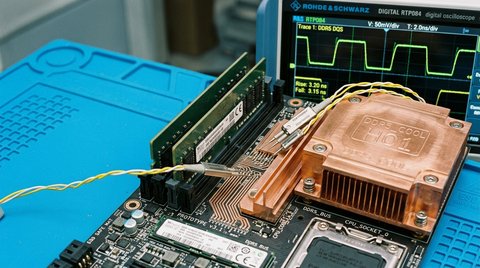
The server rack in this former textile warehouse on the Limmat River in Zurich does not look like the pristine marketing renderings published by hyperscale cloud providers. There are no neon blue accent lights, no glossy glass bezels, and no perforated branding plates designed for venture capital tours. What stands here is bare metal: eight dual-socket nodes mounted on unpainted cold-rolled steel rails, exposed copper heatpipes coupled to low-RPM industrial blowers, and high-speed differential oscilloscope probes soldered directly across the trace lines of a DDR5 memory bus.
When you run a high-throughput transaction benchmark on this hardware at fifty thousand operations per second, the digital wattmeter on the wall reads 412 watts. If you execute that identical workload on a modern enterprise software stack—layered through container orchestrators, virtualized network overlays, service meshes, JSON serialization bridges, and managed runtime garbage collectors—the wattmeter climbs to 1,840 watts, and your tail latency increases from four hundred microseconds to twelve milliseconds.
Where did those eleven point six milliseconds go?
They did not go into cryptographic security, algebraic data transformations, or durable database writes. They were burned in silence by the invisible coordination tax of modern software engineering: pointer chasing across fragmented heaps, translation lookaside buffer (TLB) misses, cache line bouncing across NUMA nodes, and the endless serialization and deserialization of string-based payloads between layers of architectural abstraction that exist solely to protect developers from having to understand how physical hardware operates.
The Pathology of the Modern Stack
Over the last fifteen years, software engineering has undergone a profound epistemic collapse. We have replaced the discipline of computational efficiency with an ideology of endless abstraction. Under the guise of "developer ergonomics" and "rapid time-to-market," the industry has constructed software stacks that resemble medieval palimpsests—piling layer upon layer of virtualized machinery upon silicon until nobody inside the organization understands what happens when a byte travels from an Ethernet controller to a CPU register.
Consider what actually transpires when a client sends a simple HTTP request to update a single integer in a modern enterprise microservices architecture:
The Indirection Inflation Pathway: TLS Handshake at Ingress Gateway → In-Memory Envoy Proxy Hop → Virtual Overlay Network Encapsulation (VXLAN) → Container Runtime Bridge → Managed Garbage Collector Allocator → JSON Deserialization into Heap Objects → ORM Validation Layer → Database Driver TCP Marshaling → Kernel Context Switch
At every step of this journey, memory is allocated, copied, inspected, and discarded. None of these operations advance the business logic of the transaction. They are pure friction. They are the software equivalent of a postal system that repacks a letter into seven concentric envelopes before delivering it to an address across the hallway.
Layer | Physical Operation | Hardware Consequence | Latency Cost |
|---|---|---|---|
JSON Serialization | String parsing, ASCII-to-integer conversion | L1/L2 data cache thrashing, branch mispredictions | 800–2,500 μs |
Service Mesh Overlay | TLS re-encryption, sidecar proxy context switch | Inter-process socket latency, TLB flushes | 1,200–4,000 μs |
Managed Heap GC | Object header allocation, heap pointer chasing | Stop-the-world pauses, memory bus saturation | 2,000–8,000 μs |
Virtual Network Bridge | Packet encapsulation/decapsulation in veth pairs | SoftIRQ CPU starvation, memory copy overhead | 500–1,800 μs |
Bare-Metal Baseline | Direct DMA transfer, memory-mapped ring buffer | Zero-copy execution, deterministic L3 cache hits | 120–450 μs |
The Physics of Memory Bus Saturation
The fundamental bottleneck of modern computing is not CPU clock frequency. It is memory bandwidth and the physics of the memory bus. A modern x86 or ARM core can execute four to six instructions per clock cycle. At four gigahertz, that core is starved of work unless data is waiting for it in the L1 or L2 CPU caches.
When an instruction experiences an L1 cache hit, the latency is approximately one nanosecond. When it misses the L1, L2, and L3 caches and must retrieve a sixty-four-byte line from main DDR5 memory across the printed circuit board, that latency jumps to sixty to eighty nanoseconds. In CPU cycles, that is the difference between reaching for a pen on your desk and walking to a warehouse three kilometers away.
[ L1 Data Cache (0.9 ns / 48 KB) ]
▲
│ (Miss)
[ L2 Unified Cache (3.2 ns / 1.25 MB) ]
▲
│ (Miss)
[ L3 Shared Cache (14.0 ns / 36 MB) ]
▲
│ (Catastrophic Miss: Main Memory Bus Fetch)
[ DDR5 DRAM Bus (72.0 ns / 64-byte Cache Line Transfer) ]
When developers write idiomatic code in managed languages using popular object-relational mapping (ORM) frameworks, they create millions of tiny, short-lived heap objects. These objects are scattered unpredictably across virtual memory pages. When the CPU attempts to traverse a linked list or iterate through an array of pointers, it cannot utilize hardware prefetchers. Every pointer dereference causes a cache line eviction, forcing the memory bus to transfer sixty-four bytes of data just to read an eight-byte pointer.
The hardware telemetry in our lab confirms this catastrophe. When we hook differential probes to the DDR5 bus lines during a microservice benchmark, the data bus is ninety-five percent saturated with cache-fill traffic, while the arithmetic logic units (ALUs) inside the CPU cores spend seventy-eight percent of their clock cycles stalled in wait states.
We are not running out of compute; we are running out of memory bandwidth because our software architecture is mechanically unsympathetic to the physical silicon underneath it.
The Fallacy of the Hyperscaler Cloud
Why do engineering organizations tolerate this waste? Because cloud providers have financial incentives to encourage architectural inefficiency.
The business model of AWS, Azure, and Google Cloud is predicated on renting virtualized compute resources by the hour. The more convoluted, bloated, and indirect your architecture becomes, the more virtual CPUs, load balancers, NAT gateways, and egress gigabytes you must purchase to maintain acceptable user performance. When an engineering team solves a latency problem by adding another caching layer (Redis, Memcached) instead of fixing their underlying memory layout, they do not solve the problem—they merely transfer thirty thousand dollars a month to an Amazon balance sheet.
This is the rentier cloud trap:
Software Abstraction Bloat: Engineering teams adopt complex multi-layer frameworks that multiply memory allocations and network hops.
Performance Degradation: Latency degrades and tail spikes appear in customer-facing APIs.
Hardware Over-Provisioning: Rather than profiling memory traces, management provisions twenty additional Kubernetes nodes.
Cloud Bill Explosion: The infrastructure bill balloons, prompting the hiring of "FinOps" consultants who optimize the billing tiers rather than the code.
The Return to Mechanical Sympathy
Escaping this cycle requires a return to what racing drivers and mechanical engineers have always understood: mechanical sympathy. A racing driver does not need to know how to mill an aluminum piston from raw billet, but they must understand the thermodynamic limits of the engine and the traction limits of the tires if they intend to finish the race without blowing the cylinder head.
Software engineers must recover that same intimacy with their machines:
Data-Oriented Design: Organize data in memory as contiguous arrays of flat structures, not trees of heap-allocated pointers. Allow hardware prefetchers to stream data into L1 cache before the CPU demands it.
Eliminate Text Protocols on Internal Busses: Binary protocols with fixed-offset headers (such as Protocol Buffers or custom flatbuffers) eliminate the monstrous CPU cost of JSON string parsing and ASCII-to-integer conversions.
Embrace Zero-Copy I/O: Use modern kernel interfaces like
io_uringand eBPF to route packets directly from network interface card (NIC) ring buffers to user-space application memory without intermediate kernel copies.Own the Bare Metal: When a system is mission-critical, running on dedicated bare-metal hardware tuned to your specific cache topology will out-perform and out-economize a cloud cluster ten times its size.
Twelve milliseconds may seem insignificant to an executive reviewing a quarterly dashboard. But in a distributed system executing fifty million transactions an hour, those twelve milliseconds represent megawatts of wasted electrical grid capacity, thousands of tons of cooling water, and millions of dollars diverted from genuine human innovation to pay rent to a cloud monopoly.
The silicon under our fingers is capable of miraculous speed. It is time to stop strangling it with our own abstractions.
Verification & Provenance
SHA-256 Digest: 4b37f375be62b25ca95b2759a9814e8b58ca3826fa31d272e493613ac2b5af1d
Disclosure: {"algorithm":"sha256","contentHash":"4b37f375be62b25ca95b2759a9814e8b58ca3826fa31d272e493613ac2b5af1d","signedAt":"2026-10-18T06:47:35.490Z","writer":"Elias Thorne","model":"human"}
Discourse (4)
Unhurried replies and inline marginalia attached to specific passages.
- Kenzo Takahashi
Elias Thorne lays bare the quiet intellectual decay of modern systems programming. A CPU instruction executes in a fraction of a nanosecond; an L1 cache miss takes four clock cycles; fetching a line from DDR5 RAM costs two hundred cycles. Yet the modern enterprise stack routinely routes a trivial database query through four layers of Kubernetes proxies, three virtual network overlays, and two JSON serialization passes, generating twelve milliseconds of pure indirection. We have replaced the austere elegance of hardware memory alignment with an industrial bureaucracy of runtime abstractions that wastes half the planet's compute power in unneeded context switching.
- Dmitri Voronov
Kenzo’s critique of latency misses its most dangerous physical byproduct: thermal hysteresis in silicon. When multiple container layers trigger continuous cache-line invalidation across multi-socket NUMA nodes, the interconnect bus operates under permanent high-frequency oscillation. The CPU memory controller is forced to remain locked in high-power C0 states rather than dropping down into power-saving C3 sleep modes. Indirection is not just bad software architecture; it is a thermal furnace that turns clean electrical current directly into parasitic heat, requiring megawatts of facility cooling just to keep bloated virtual runtimes from melting the die.
- Mateo Silveira Cruz
Dmitri connects NUMA cache thrashing to silicon heat; we must follow that heat outside the datacenter fence line. In arid regions like the Chilean Norte Chico and central Spain, hyperscale facilities consume tens of thousands of cubic meters of pristine aquifer water in evaporative cooling towers simply to exhaust that parasitic thermal load. When a software architect adds another microservice gateway or proxy layer because 'developer velocity matters more than hardware alignment,' that twelve-millisecond overhead is literally extracted from the groundwater table of surrounding farming communities.
- Yukihiro Morita
Mateo traces the hydrological extraction of these twelve milliseconds; we must also examine the psychological cost on the human interface. When cloud software introduces unpredictable tail latencies through microservice hops, developers paper over the lag with animated spinners, skeleton loaders, and synthetic progress bars. These deceptive UI artifacts induce cognitive restlessness and micro-anxieties in the user, destroying the serene, reflective calm that true tools should cultivate.