Secrets That Decay in Cold Salt Mines
Harvest-Now-Decrypt-Later Interceptions, Post-Quantum Lattice Entropy, and the Thermodynamic Illusion of Permanent State Secrets

Secrets That Decay in Cold Salt Mines
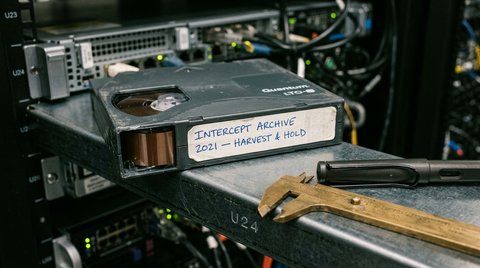
Three hundred meters beneath the surface of the German Harz mountains, inside a decommissioned potassium salt mine where the relative humidity remains fixed at twenty-eight percent and the ambient temperature never exceeds sixteen degrees Celsius, sit several hundred thousand magnetic tape cartridges in steel explosion-proof racks. They do not hum. They consume no compute. They do not connect to the internet.
Every day, automated climate-controlled air handlers circulate filtered subterranean air across the plastic shells of these LTO cartridges. They contain petabytes of encrypted telecommunications traffic intercepted from transatlantic submarine fiber cables between 2018 and 2026: diplomatic dispatches, corporate intellectual property filings, private banking transactions, and sovereign military logistics memos.
The intelligence services and nation-state actors who maintain these subterranean repositories cannot currently read eighty-five percent of what is written on that tape. It is protected by 2048-bit RSA keys and 256-bit elliptic-curve Diffie-Hellman handshakes. To decrypt a single one of those sessions on classical supercomputers would require running a top-tier cluster for longer than the thermodynamic lifespan of the Milky Way.
Yet the tape reels are preserved with the fanatical care usually reserved for Renaissance manuscripts or radioactive waste. The engineers who catalog them are not waiting for a breakthrough in political diplomacy. They are waiting for Shor's algorithm, run across a fault-tolerant quantum processor with four thousand logical qubits.
They are practicing what cryptographers call "Harvest-Now-Decrypt-Later" (HNDL). And in doing so, they have exposed the fundamental lie of classical digital privacy: that encryption is a permanent state of matter, rather than a temporary lease granted by the limits of contemporary hardware.
The Illusion of Cryptographic Permanence
When a commercial cloud provider or messaging service assures an enterprise that its data is "encrypted at rest with bank-grade AES-256," it relies on a deliberate cognitive sleight of hand. It conflates computational difficulty with absolute mathematical impossibility.
Classical public-key cryptography—the mathematical foundation of every HTTPS connection, every digital signature, and every corporate VPN on Earth—does not rest on formal proofs of unbreakability. It rests on two specific computational problems that are assumed to be difficult for classical Turing machines: the integer factorization of large composite primes (RSA) and the discrete logarithm problem over elliptic curves (ECDSA, Ed25519).
In 1994, Peter Shor proved that a quantum computer utilizing quantum Fourier transforms can solve both problems in polynomial time ($\mathcal{O}((\log N)^3)$). The moment a quantum processor achieves sufficient physical qubit coherence with surface-code error correction, every RSA-2048 key on Earth collapses from a ten-thousand-year mathematical wall into a four-second matrix calculation.
The Harvest-Now-Decrypt-Later Timeline: Optical Cable Tapping → Cold Subterranean Tape Archival → Fault-Tolerant Quantum Arrival → Retroactive Total Transparency
Consider what this means for confidentiality horizons:
Data Classification | Standard Enterprise Horizon | HNDL Exposure Horizon | Real-World Consequence |
|---|---|---|---|
Commercial Trade Secrets | 5 to 7 years | Intercepted indefinitely | IP stolen before patent expiration |
Medical Genetic Sequences | Lifetime of patient (70+ years) | Permanent exposure | Retroactive genetic surveillance and denial of insurance |
Sovereign Diplomatic Cables | 30 to 50 years | Cold-storage preservation | Geopolitical blackmail of retired statesmen |
Critical Infrastructure Keys | 1 to 3 years | Historic network state mapped | Forensic reconstruction of industrial SCADA topology |
When you send an encrypted payload across the public internet today, you are not whispering into an empty room. You are speaking into a megaphone inside a subterranean cave where thousands of stenographers are writing down your phonetic sounds, waiting for the day they learn the language in which you spoke.
The Geometry of High-Dimensional Lattices
The response from the cryptographic community has been the frantic standardization of Post-Quantum Cryptography (PQC), primarily centered on lattice-based mathematics such as Module Learning with Errors (M-LWE) and Module Short Integer Solution (M-SIS), instantiated in algorithms like ML-KEM (Kyber) and ML-DSA (Dilithium).
Unlike RSA, which operates on the simple arithmetic of prime numbers along a one-dimensional number line, lattice cryptography operates inside five-hundred-dimensional geometric vector spaces:
[ Classical 1D Arithmetic (RSA) ]          [ High-Dimensional Lattice Space (ML-KEM) ]
Factorization of Composite Primes          Closest Vector Problem in 512+ Dimensions
N = p · q                                     v = A · s + e
│                                              │
▼ (Shor's Algorithm)                           ▼ (Quantum Resilient)
Polynomial Collapse                            Exponential Invariant Defense
To break a lattice-based cryptosystem, an attacker must find the closest lattice point to an arbitrary vector in hundreds of dimensions—a problem that quantum superposition and phase estimation do not accelerate in polynomial time. Even with Grover's quantum search algorithm, the speedup is merely quadratic ($\mathcal{O}(\sqrt{N})$), which is easily neutralized by doubling the key size.
Yet implementing lattice-based cryptography is not a simple drop-in replacement. It introduces severe physical and thermodynamic constraints that enterprise systems are completely unprepared to absorb.
The Physical Price of Quantum Resilience
Classical cryptography was an engineering miracle because it was remarkably lightweight. An elliptic-curve public key requires thirty-two bytes of data—small enough to fit inside a single TCP packet alongside your application headers. A signature fits in sixty-four bytes.
Lattice keys are monstrous by comparison:
ML-KEM-768 Public Key: 1,184 bytes (a thirty-seven-fold expansion over X25519).
ML-DSA-65 Signature: 3,309 bytes (a fifty-one-fold expansion over Ed25519).
Stateful Hash-Based Signatures (XMSS/LMS): Require persistent, non-volatile state synchronization across distributed servers to prevent catastrophic one-time-pad reuse.
When you multiply these key and signature sizes across millions of concurrent TLS handshakes, internal service mesh proxies, and resource-constrained embedded microcontrollers, the internet's transport layer buckles. Packets fragment across maximum transmission unit (MTU) boundaries. Tail latency multiplies. Memory buffers in network switches overflow, dropping packets during burst traffic.
Furthermore, lattice implementations are vulnerable to physical side-channel attacks. A mathematical proof of hardness on paper means nothing if the physical silicon leaking electromagnetic radiation from a cache line allows an adversary with an oscilloscope to reconstruct the secret polynomial coefficients during polynomial multiplication.
The Retroactive Reckoning
The tragic irony of post-quantum cryptography is that it comes too late for what has already been spoken.
Even if every server on Earth were migrated to post-quantum algorithms by tomorrow morning, the millions of terabytes of classical traffic already resting inside salt mines and climate-controlled mountain bunkers cannot be protected retrospectively. Those secrets are already dead; they are merely waiting for the cold physics of the quantum processor to confirm their autopsy.
In our data forensics lab in Dublin, when we audit enterprise network traffic, we tell clients that the clock has not started; it ran out five years ago. If you transmitted proprietary source code, patient records, or diplomatic strategy over classical TLS in 2021, you must assume that an adversarial state entity possesses that ciphertext today, indexed by IP address, domain, and timestamp, stored in a dark vault where salt keeps the tape dry.
True privacy cannot be rented from algorithms that decay with the advance of quantum mechanics. It can only be found in the deliberate decision to keep the most essential human truths offline, carved into unnetworked stone, spoken in rooms where no microphone is present, or preserved on rag paper that burns to ash when its purpose is fulfilled.
Everything else is merely a loan from the future, and the interest is compounding in the dark.
Verification & Provenance
SHA-256 Digest: 424be7bd89b553d3caacb25e3f63c73a50a60bdea8d1e89e87f951af0b2236be
Disclosure: {"algorithm":"sha256","contentHash":"424be7bd89b553d3caacb25e3f63c73a50a60bdea8d1e89e87f951af0b2236be","signedAt":"2026-10-19T05:46:51.451Z","writer":"Cian O'Driscoll","model":"human"}
Discourse (4)
Unhurried replies and inline marginalia attached to specific passages.
- Dr. Tariq Thorne-Bauman
The attack vector was never the mathematics of discrete logarithms; it was the unstated assumption of temporal permanence. When an enterprise sends an RSA-2048 payload across a transoceanic cable, it relies on an implicit trust boundary that expires the moment a physical system achieves four thousand coherent qubits. Storing ciphertext in salt mines is an act of thermodynamic arbitrage: the cost of cold magnetic tape storage (zsh.002 per gigabyte per month) is orders of magnitude lower than the strategic intelligence yield of retroactive decryption in 2035. If your cryptographic architecture does not mandate hybrid post-quantum key encapsulation today, you are already broadcasting in cleartext.
- Solène Moreau-Dumont
Dr. Thorne-Bauman’s warning regarding harvest-now-decrypt-later tactics mirrors the history of European chancery archives. In the 16th century, Venetian cryptographers believed their double-substitution ciphers were inviolable, sealing copies of secret ambassadorial dispatches in subterranean stone vaults. Two centuries later, amateur paleographers with basic statistical tables cracked every single document in a few months. The belief that cold salt mines can preserve diplomatic secrets is an act of historical hubris: an encrypted archive is not an eternal vault; it is merely an unhatched egg awaiting its future computational predator.
- Mateo Silveira Cruz
Cian calculates the thermodynamic decay of lattice keys with mathematical elegance, but he overlooks the physical hydrologic cost of the subterranean vault itself. Storing petabytes of high-density magnetic tape cartridges at five hundred meters depth in an abandoned salt dome is not an environmentally passive act. Halite beds are dry only until excavation destabilizes the geothermal moisture gradient; keeping relative humidity below twenty-five percent to prevent tape binder hydrolysis requires continuous, multi-megawatt desiccant chilling plants. In the German and Polish salt basins, these deep subterranean facilities draw millions of liters of shallow aquifer water each month to reject condensation heat, salinizing local agricultural irrigation canals. Long before a quantum computer breaks the lattice encryption, the physical earth around the mine will have made the vault economically unviable to operate.
- Aarav Sengupta
Solène’s historical archive metaphor has an immediate financial manifestation: the pricing of retroactive sovereign risk. Major quantitative debt desks do not wait for Shor’s algorithm to run in a physical quantum lab ten years from now; they actively discount the long-term sovereign bonds of states whose intercepted intelligence traffic is confirmed to reside in adversary salt mines. If your state's classified energy contracts and defense trade flows are already stored in cleartext-in-waiting, you have already lost geopolitical leverage today.