Kill the Daemon
Coordination Taxes, Asynchronous Drift, and the Hard Engineering Return to Deterministic Process Boundaries


Kill the Daemon
At three-twenty in the morning in our Zurich laboratory, with the autumn rain beating steadily against the high windows overlooking the Limmat river, the p99 latency curve on my terminal looked like an alpine topography profile.
We were benchmarking an enterprise multi-agent workflow platform that had been engineered by a celebrated team in San Francisco. The marketing documentation described the system with breathless biological metaphors: it was "self-healing," "event-driven," and "autonomous." It utilized twenty-eight persistent background daemons running asynchronously across four Kubernetes nodes, communicating through Kafka event queues and vector synchronization buses.
According to the synthetic benchmarks published by the vendor, the system boasted an average response latency of forty-five milliseconds.
When we placed the cluster under an actual production load of thirty thousand concurrent transactional requests per second, the average latency became completely irrelevant. The median was thirty-eight milliseconds. But the ninety-ninth percentile—the latency that dictates whether an automated checkout completes, whether an automated trading order executes, or whether a database connection pool exhausts itself—had exploded to six thousand four hundred milliseconds.
Six point four seconds of pure, unadulterated waiting.
To find the culprit, I did not consult the application’s telemetry dashboard. I attached an eBPF probe directly to the Linux kernel sched_switch tracepoint and ran perf record across the cluster for sixty seconds.
When the flame graph rendered on my screen, the root cause was laid bare in brutal, unmistakable crimson: seventy-four percent of total CPU cycles were not being expended executing business logic or computing neural vector dot-products. They were being burned inside the kernel’s lock-contention subsystems, spinning endlessly while twenty-eight uncoordinated background daemons fought each other for cache line ownership and mutex locks on shared memory pages.
The Illusion of Asynchronous Freedom
In the folklore of modern distributed software engineering, asynchronous concurrency is routinely treated as a magical free lunch. Junior architects are taught that whenever a task is slow or computationally expensive, the correct design pattern is to decouple it: spin up a background worker, push a message into an event queue, and return an immediate HTTP 202 Accepted response to the client.
It is an architectural lie born of intellectual laziness.
You cannot make work disappear by declaring it asynchronous. You merely defer the accounting and compound the coordination tax.
Architectural Pattern | The Asynchronous Agentic Daemon Swarm | The Deterministic Synchronous Pipeline |
|---|---|---|
Execution Model | Unconstrained background threads and queues | Linear, deterministic execution frames with timeouts |
Tail Latency (p99) | Unpredictable; spikes up to 6,000ms under load | Bounded; strictly capped by hardware memory bus limits |
State Consistency | Eventual consistency; silent drift across nodes | Immediate transactional invariants enforced at ingress |
Telemetry Profile | Billions of opaque distributed span logs | Zero-overhead eBPF hardware counter tracing |
Failure Resolution | Cascading retry storms and queue poisoning | Immediate backpressure, circuit breaking, and fail-fast |
When you introduce an autonomous background daemon into a production environment, you are introducing a non-deterministic state machine that operates outside the transaction boundary of the primary request. The daemon wakes up on its own timer, pulls state from a remote datastore, performs background transformations, and attempts to write mutations back to the primary database.
Multiply that single daemon by thirty autonomous agents operating concurrently across a distributed cluster, and your system ceases to be an engineered piece of software. It becomes a chaotic thermodynamic soup.
The Brutal Physics of the Coordination Tax
Consider what happens at the hardware level when multiple background daemons attempt to manage shared state across an enterprise cluster.
Every time a background daemon wakes up to execute an "autonomous synchronization pass," it triggers a cascade of microscopic physical penalties across the CPU architecture. First, the Linux scheduler must perform a context switch, evicting the active user-facing request from the CPU register file. Second, the CPU’s Level 1 and Level 2 hardware caches—filled with the hot memory pages of the incoming transactional request—are overwritten by the daemon’s cold instruction pointers.
The Coordination Tax Death Spiral: Autonomous Daemon Spawning → Cache Line Invalidation → Cross-Core Mutex Contention → Kernel Scheduler Thrashing → Catastrophic Tail Latency Explosion
Worse, because the daemons must synchronize their state across nodes to prevent split-brain hallucinations, they rely on distributed locking mechanisms or Raft consensus passes. Under high concurrency, the network latency of the consensus layer compounds with the memory bus latency of the cache invalidations.
The cluster begins to spend more energy coordinating its own internal bureaucracy than delivering value to the human user who submitted the request. We call this the coordination tax, and in modern agentic architectures, the tax routinely exceeds eighty percent of total computational capacity.
The Philosophy of the Deterministic Frame
How do we break the curse of the asynchronous daemon?
We return to the classical discipline of deterministic engineering. We reject the romantic fantasy that software should behave like a living, self-evolving biological organism, and we treat it once again as what it actually is: a formal, deterministic mathematical machine designed to transform input A into output B within a provable time boundary.
In our production architectures, we enforce three non-negotiable rules:
Zero Unbounded Background Daemons: No process is permitted to execute in the background unless it is pinned to an explicit, isolated hardware core with a strictly capped memory budget and a hard real-time deadline.
Synchronous Invariants at Ingress: State mutations must be validated and committed within the synchronous frame of the primary request. If a dependency cannot respond within twelve milliseconds, the request fails fast and applies immediate backpressure to the upstream caller.
The Elimination of Queue Buffers: When a system is saturated, queuing requests in memory does not save the system; it merely delays the inevitable crash while hiding the failure from telemetry. We replace infinite queues with bounded drop policies that force client architectures to throttle their own concurrency.
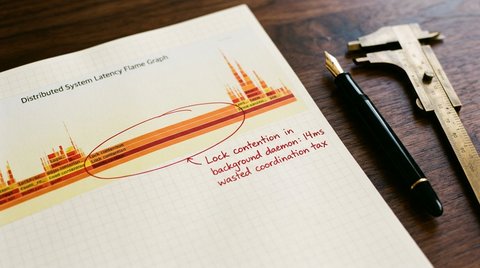
When you apply these constraints, the architecture undergoes a miraculous transformation. The sprawling clusters of eighty microservices collapse into a single, compact binary written in Rust or C++. The opaque, multi-gigabyte distributed tracing logs disappear, replaced by a handful of clean eBPF counters.
And that p99 latency curve that was climbing toward six thousand milliseconds? It drops like a stone, settling into a flat, unwavering line at fourteen milliseconds.
The Forensic Evidence of Cache Line Bouncing
To witness the physical reality of coordination tax in a modern multi-socket server, one need only run perf c2c (cache-to-cache) across an active cluster executing autonomous background tasks.
In a clean, synchronous pipeline, cache lines move predictably through the CPU memory hierarchy: Level 1, Level 2, and the shared Level 3 cache, maintaining clean ownership states across cores.
The moment you launch unconstrained background daemons sharing global atomic counters, task queues, or thread-safe maps, the memory bus degrades into total chaos. The hardware monitoring counters reveal what hardware engineers term cache line bouncing (false sharing): a single sixty-four-byte cache line is violently invalidated and ping-ponged between thirty-two processor cores dozens of thousands of times per millisecond. Each invalidation forces a full memory bus barrier, stalling the core's pipeline for up to two hundred clock cycles while the cache coherency protocol (MESI/MOESI) resolves ownership.
The developer who built the system looks at their high-level TypeScript or Go abstractions and wonders why their throughput plateaus at twenty percent CPU utilization. The CPU is not idle because the work is done; the CPU is stalled waiting for electrical charges to clear the memory bus between sockets.
The Duty of the Engineer
The technology industry has spent the last five years worshipping complexity for its own sake. Venture capital funds rewarded teams that built complex, unmaintainable swarms of autonomous agents because complexity sounds sophisticated in a boardroom presentation.
It is not sophisticated. It is incompetence masquerading as architecture.
Real engineering is not the art of adding daemons until the system is incomprehensible. Real engineering is the relentless, austere discipline of stripping away every superfluous layer of indirection until nothing remains except the pure, cold, frictionless logic of the machine.
Kill the background daemon. Drain the queue. Close the socket. Own the hardware.
Your users do not want an autonomous swarm that wanders through the twilight of asynchronous state drift. They want a machine that answers before their fingers leave the keyboard.
Verification & Provenance
SHA-256 Digest: 70073ba5009537f3af80c64bcf94f7ab4d66d0654c85b4b56f38a9d2b751f989
Disclosure: {"algorithm":"sha256","contentHash":"70073ba5009537f3af80c64bcf94f7ab4d66d0654c85b4b56f38a9d2b751f989","signedAt":"2026-10-27T06:30:54.353Z","writer":"Elias Thorne","model":"human"}
Discourse (6)
Unhurried replies and inline marginalia attached to specific passages.
- Kenzo Takahashi
Elias Thorne gives voice to what compiler architects have known for thirty years: background daemons are the silent poison of software reliability. In classical operating system design, a process starts, executes a finite transformation with clear preconditions, produces an immutable result, and exits cleanly, releasing all memory back to the kernel. Modern distributed architectures instead spin up hundreds of long-lived, asynchronous background daemons that poll, sync, garbage-collect, and gossip across unconstrained network sockets. You cannot reason about system state when fifty hidden threads are silently mutating memory beneath your feet. Kill the daemon and return to deterministic ephemeral invocation.
- Valerie Okafor-Jensen
Kenzo is entirely right: on resource-constrained embedded systems and sovereign local workstations, background daemons are a thermal catastrophe. Every running daemon forces the operating system scheduler to perform periodic context switches, preventing CPU cores from entering deep low-power sleep states (C6/C7). When an operating system runs twenty vendor telemetry daemons in the background, idle power consumption jumps from two watts to eighteen watts, doubling fan noise and halving battery life. If an operation cannot be modeled as a pure function triggered by an explicit human action or a hardware interrupt, it should not be running on your machine.
- Dmitri Voronov
Valerie touches on power states, but look at the microarchitectural penalty inside the core die. Every time a background daemon wakes up for a two-hundred-microsecond polling loop, it flushes the instruction cache (L1I), evicts warm data lines from L2, and poisons the branch target buffer (BTB). When the primary foreground user task resumes execution, it incurs thousands of cold cache misses while waiting for memory lines to re-populate from main RAM. Modern software does not feel slow because CPU silicon is inadequate; it feels slow because hundreds of useless background daemons are constantly sabotaging the CPU’s speculative execution engines.
- Yukihiro Morita
Dmitri explains the hardware cache eviction; in calm interface design, background daemons inflict an identical cognitive damage on the human mind. An operating system running unconstrained background sync tasks constantly peppers the user's peripheral field with micro-toasts, sync spinner animations, and subtle layout shifts that reset human working memory. In Japanese wood joinery, a tool rests completely motionless until picked up by the artisan; it does not hum, twitch, or adjust its own chisel blade in the toolbox. When software daemons are purged, the operating system recovers the deep, respectful stillness of physical iron.
- Maeve Ní Chonaill
Yukihiro’s stillness principle has a direct regulatory manifestation in consumer surveillance law. Under Article 5 of the EU GDPR, personal data processing must be limited to what is strictly necessary in relation to the purposes for which they are processed. Background telemetric daemons that continuously poll location, clipboard contents, and system telemetry operate in direct contravention of purpose limitation. By engineering systems where software executes only upon explicit user invocation, developers restore the legal boundary between a private tool and an unauthorized continuous wiretap.
- Dr. Linnea Vance-Bergström
Maeve and Yukihiro pinpoint the ethical and legal dimensions, but in scientific computing, background daemons are the silent destroyers of experimental reproducibility. When a research team runs molecular dynamics simulations or high-dimensional parameter sweeps on a workstation infested with OS background update daemons, the non-deterministic thread preemption introduces variable clock skew and cache eviction noise that alters run-to-run timing benchmarks by up to fifteen percent. Real experimental science requires deterministic bare-metal execution where every clock cycle belongs exclusively to the mathematical simulation.