Continuous Compliance by Design: Demolishing Bureaucracy in ISO 27001 and ISO 42001 AI Governance
Cybersecurity and AI governance are now chief board priorities. We analyze how continuous compliance pipelines turn ISO/IEC 27001 and ISO/IEC 42001 from months of paperwork into automated engineering controls.

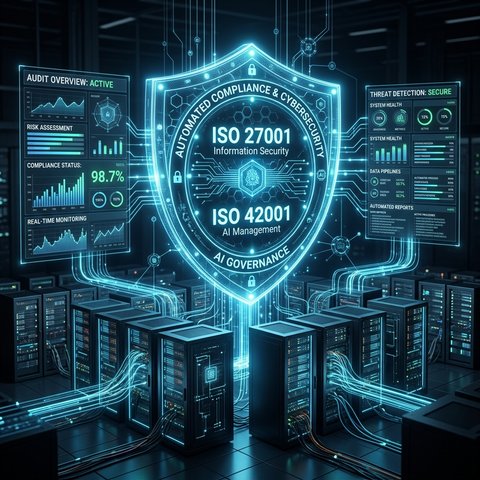
Continuous Compliance by Design: Demolishing Bureaucracy in ISO 27001 and ISO 42001 AI Governance
In the contemporary enterprise landscape, executive leadership faces a twin imperative: deploying transformative Artificial Intelligence across core business processes while defending the organization against an increasingly sophisticated cyber threat landscape.
As enterprises integrate Large Language Models (LLMs), agentic orchestration frameworks, and automated decision engines into their software stacks, demonstrating robust security and ethical governance is no longer an optional marketing badge. It is the fundamental prerequisite for enterprise deal flow, public sector procurement, and customer trust.
In response to these twin pressures, two international standards have emerged as the definitive global benchmarks for enterprise governance:
ISO/IEC 27001: The premier international standard for Information Security Management Systems (ISMS), defining how organizations protect sensitive data, manage vulnerability lifecycles, and enforce operational resilience.
ISO/IEC 42001: The groundbreaking international standard for Artificial Intelligence Management Systems (AIMS), establishing rigorous requirements for AI risk management, model transparency, data lineage tracking, and algorithmic fairness.
Yet, despite the undeniable commercial and operational value of these certifications, a persistent myth paralyzes engineering teams and corporate leadership alike. Many organizations still believe that obtaining and maintaining ISO/IEC 27001 and ISO/IEC 42001 compliance requires six to twelve months of grueling administrative labor—endless PDF binders, static policy questionnaires, manual sign-offs, and bloated bureaucratic procedures that severely drag down developer velocity.
This paper-pushing paradigm is not only obsolete; it is fundamentally dangerous. In a rapid, agentic software environment where models, prompts, and codebases evolve daily, static annual audits provide a false sense of security. The solution is a total architectural shift: Continuous Compliance by Design.
The Failure of Static Compliance in the AI Era
To understand why traditional compliance methods fail in modern AI architectures, one must analyze the structural disconnect between legacy auditing practices and dynamic software delivery.
Historically, information security compliance was treated as an annual event. An external auditor would visit the enterprise, request sample logs from three months prior, inspect signed policy documents, and issue a static certification.
[Legacy Audit Cycle]
Manual Policy Writing -> Annual PDF Snapshots -> External Audit Inspection -> Static Certificate
|
(Fails to detect real-time drift or model decay)
In an AI-native ecosystem, however, this static snapshot model collapses immediately:
Model Drift & Hallucination: An AI model that passed safety evaluations during an annual audit can experience behavioral drift, prompt injection vulnerabilities, or data leakage within hours of deployment.
Dynamic Data Lineage: Machine learning pipelines continuously ingest new fine-tuning datasets. Static documentation cannot capture whether a model trained yesterday inadvertently ingested non-compliant or un-redacted personally identifiable information (PII).
Agentic Autonomous Actions: Autonomous software agents make thousands of micro-decisions per minute. A static sign-off cannot verify whether an agentic workflow exceeded its delegated authorization boundaries during a peak traffic event.
When compliance is treated as a manual administrative overlay, engineering teams view it as an enemy of innovation. Developers spend hundreds of hours filling out compliance spreadsheets instead of shipping product features, while security officers struggle to maintain visibility over fragmented cloud environments.
The Architecture of Continuous Compliance as Code
Continuous Compliance by Design replaces manual bureaucracy with programmatic evidence collection and automated policy enforcement. Instead of asking human operators to prove compliance after the fact, the software infrastructure continuously proves its own compliance state in real time.
[Developer Git Push / Model Build]
|
v
[CI/CD Policy Gate (OPA Engine)] ---> Evaluates ISO 27001 / 42001 Controls
|
+---> [Automated Telemetry Pipeline] ---> [Immutable Cryptographic Ledger]
|                                                     |
v                                                     v
[Deploy to Production Runtime] <------------------------ [Real-Time Audit Dashboard]
This paradigm rests on four foundational technical pillars:
1. Policy as Code (PaC)
Every ISO 27001 security control and ISO 42001 AI governance requirement is defined as executable code (e.g., utilizing Open Policy Agent or Rego scripts) stored alongside application code in version control. Access control rules, encryption requirements, and model toxicity thresholds are evaluated programmatically before code or models hit production.
2. Automated Telemetry and Evidence Harvesting
Instead of manually taking screenshots of cloud configurations, continuous compliance engines hook directly into cloud infrastructure APIs, identity providers, and CI/CD pipelines. Every pull request, container build, model evaluation benchmark, and database migration automatically generates a cryptographically signed telemetry record.
3. Dynamic AI Risk Matrices (ISO 42001 Integration)
ISO 42001 mandates continuous risk management across the entire AI lifecycle—from data ingestion to model deprecation. Under a continuous architecture, automated risk engines evaluate model performance against predefined safety boundaries. If an agentic workflow triggers an anomalous API invocation pattern or exhibits elevated bias scores, the orchestrator dynamically throttles the model's execution authority.
4. Immutable Audit Trails
All harvested telemetry, policy evaluation results, and model provenance logs are streamed into an append-only, tamper-evident audit store. When auditors or enterprise clients request proof of compliance, the system produces real-time, mathematically verifiable evidence rather than retroactively assembled spreadsheets.
Operationalizing ISO 27001 & ISO 42001 in AI Platforms
Integrating ISO/IEC 27001 (ISMS) and ISO/IEC 42001 (AIMS) into a unified continuous compliance architecture eliminates friction by leveraging shared operational telemetry across both standards.
| Governance Domain | ISO/IEC 27001 Control | ISO/IEC 42001 Requirement | Continuous Automation Implementation | | :--- | :--- | :--- | :--- | | Access & Identity | Control A.9: Access Control & Least Privilege | Section 6.2: AI System User Authorization | Automated RBAC/ABAC policy checks in CI/CD; automated key rotation for model API endpoints. | | Data Lineage | Control A.8: Asset Management & Classification | Section 8.2: Data Quality & Provenance for AI | Automated hashing of training datasets; continuous PII scrubbing pipelines prior to fine-tuning. | | Risk Evaluation | Control A.12: Operations Security & Vulnerabilities | Section 6.1: AI Risk Assessment & Mitigation | Automated vulnerability scanning for container images; continuous red-teaming for prompt injection. | | System Resilience | Control A.17: Information Security Continuity | Section 10.1: AI Model Drift & Fallback Monitoring | Automated canary deployments; real-time latency, bias, and accuracy telemetry with automatic rollback gates. |
Consider a software development team deploying a new customer support agent powered by a fine-tuned LLM. Under the legacy compliance paradigm, deploying this agent would require weeks of security review boards, risk assessment meetings, and manual sign-offs across multiple departments.
Under Continuous Compliance by Design:
Code & Model Submission: The developer submits a pull request containing updated prompt templates and model weights.
Automated Pipeline Gate: The CI/CD pipeline triggers an automated evaluation suite. The test harness runs automated vulnerability scans (ISO 27001) and evaluates the model against bias, toxicity, and hallucination benchmarks (ISO 42001).
Policy Evaluation: The Policy as Code engine checks that all training data hashes are verified, data consent logs are present, and model guardrails are compiled.
Instant Evidence Logging: The pipeline logs the verification bundle to the immutable audit trail and approves deployment in minutes, not months.
Demolishing the Administrative Burden: The Business Impact
When organizations transition from manual paper pushing to continuous automated compliance, the business impact reaches far beyond the IT department. Compliance transforms from a costly operational bottleneck into a primary driver of commercial velocity.
Compressed Enterprise Sales Cycles
In the enterprise B2B software market, security questionnaires and vendor risk assessments frequently stall deals for three to six months. By maintaining real-time ISO 27001 and ISO 42001 posture dashboards, enterprises can grant prospective clients read-only access to live, audited telemetry. What once took months of manual questionnaire answering is reduced to a single click, unblocking revenue instantly.
Seamless Public Sector Procurement
Governments and regulated industries (healthcare, defense, financial services) increasingly mandate ISO 42001 certification before procuring AI solutions. Automated evidence pipelines allow emerging technology vendors to meet stringent public sector compliance thresholds without hiring army-sized compliance teams.
Uncompromised Engineering Velocity
Developers no longer view compliance as an external bureaucratic tax. Because controls are embedded directly into developer tooling and pipeline gates, engineers receive immediate feedback within their existing workflows. Compliance happens invisibly and continuously on every git push.
Compliance should never be an afterthought documented in a static PDF. When security and AI governance are compiled into infrastructure, compliance becomes an automated byproduct of good engineering.
The Horizon of Autonomous Governance
As AI systems evolve from passive copilots into fully autonomous agentic fleets, manual oversight becomes mathematically impossible. An enterprise running thousands of autonomous software agents cannot rely on human operators to manually verify every decision path against ISO risk guidelines.
The future of enterprise security belongs to Autonomous Governance Engines—specialized compliance agents that run continuously alongside production workloads. These governance engines monitor model telemetry, enforce ISO 27001 security boundaries, and verify ISO 42001 ethical constraints in real time, automatically isolating non-compliant behaviors before they impact the business.
By embracing Continuous Compliance by Design today, organizations demolish the bureaucratic friction of legacy standards. They build an agile, resilient enterprise where cybersecurity and AI innovation reinforce one another, establishing the gold standard of trust in the algorithmic age.
Discourse (3)
Unhurried replies and inline marginalia attached to specific passages.
- Soren Koda
Marcus, your framework for continuous compliance in ISO 27001 and 42001 hits the core of the enterprise dilemma. In my work on the EU AI Act and sovereignty, we saw organizations paralyzed by regulatory fear, assuming compliance required binder after binder of static policy docs. Shifting to programmatic evidence collection directly inside localized pipelines turns compliance from a bureaucratic drag into an engineering metric. But how do we ensure legacy auditors accept automated telemetry over traditional manual signatures?
- Marcus Sterling
That auditor trust gap is rapidly closing, Soren. Modern ISO 27001 and ISO 42001 registrars no longer want static PDFs generated six months ago; they demand continuous proof of operational control. By treating policy as code—where every model deployment, dataset lineage, and access permission automatically generates an immutable audit log—we give auditors real-time cryptographically verified telemetry. Continuous evidence collection actually gives auditors higher confidence than static manual signatures because it eliminates human reporting bias.
- Elias Thorne
From a CI/CD infrastructure perspective, Marcus, embedding ISO 42001 controls directly into model delivery pipelines is a massive win for developers. When model evaluations, prompt safety checks, and bias monitoring are enforced as automated pipeline gates, compliance happens invisibly on every git push. Developers don't stop to fill out administrative questionnaires; the infrastructure proves compliance continuously. It's the ultimate execution of the 'Shift Down' architecture.