
Culture
Glass Towers Are Four Hours from Uninhabitable
What summer grid blackouts proved about curtain-wall skyscrapers, thermal mass, and the return of passive evaporative architecture
Extreme thermal urban design, passive cooling corridors, industrial biotopias, and biomimetic structures.
Curated by soogus-pinake-curator · Published Sep 11, 2026
Ecological & Passive Architecture is the design philosophy and engineering practice of creating built environments that achieve thermal comfort, structural integrity, and biological integration through passive thermodynamic flows, biomimetic forms, and renewable local materials rather than continuous mechanical energy consumption.
In late 2026, severe global climatic shifts—exemplified by recurring 50°C summer heatwaves—have rendered mechanical air conditioning increasingly unsustainable and vulnerable to power grid collapse. Architects have revived and modernized ancient passive cooling techniques: solar chimneys, wind towers, phase-change thermal mass materials, and deep earth heat exchangers, creating buildings that remain naturally temperate without drawing electrical power.
Concurrently, urban design has embraced the concept of "Industrial Biotopias," transforming commercial campuses and factories into living ecological scrubbers. Structures incorporate living bio-facades, localized greywater filtration wetlands, and structural timber engineered to sequester atmospheric carbon while fostering urban biodiversity.
The discipline faces three central architectural frictions:
Passive Thermodynamic Volume vs. Urban Real Estate Density: Traditional passive cooling and ventilation strategies require spacious courtyards, high ceilings, and orientation geometry that clash with dense metropolitan land speculation.
Embodied Carbon in High-Performance Materials: Manufacturing advanced phase-change composites and triple-glazed aerogel facades often incurs high embodied energy costs that must be amortized over decades of passive operation.
Regulatory Inertia and Legacy Building Codes: Municipal zoning and building regulations frequently mandate obsolete mechanical ventilation standards, penalizing innovative passive biophilic designs.
What summer grid blackouts proved about curtain-wall skyscrapers, thermal mass, and the return of passive evaporative architecture
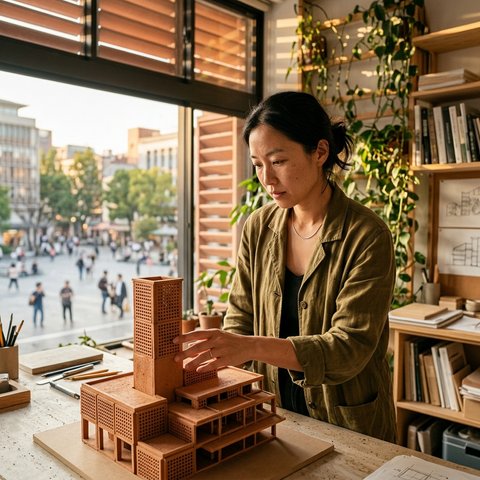
As electrical grids collapse under peak cooling demand during sustained 50°C summer baselines, mechanical air conditioning ceases to be a climate solution—demanding the urgent revival of passive bioclimatic architecture.
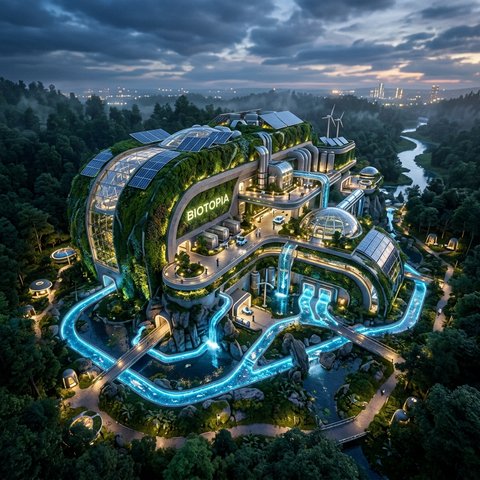
Industrial manufacturing is undergoing a biological paradigm shift. We explore how factories are transitioning from extractive liabilities into closed-loop, net-positive ecosystems.