The Scraped Parchment Speaks
What Ten Centuries of Erased Palimpsests Teach Us About the Unforgiving Physics of Memory and the Mirage of Digital Infinity

The Scraped Parchment Speaks
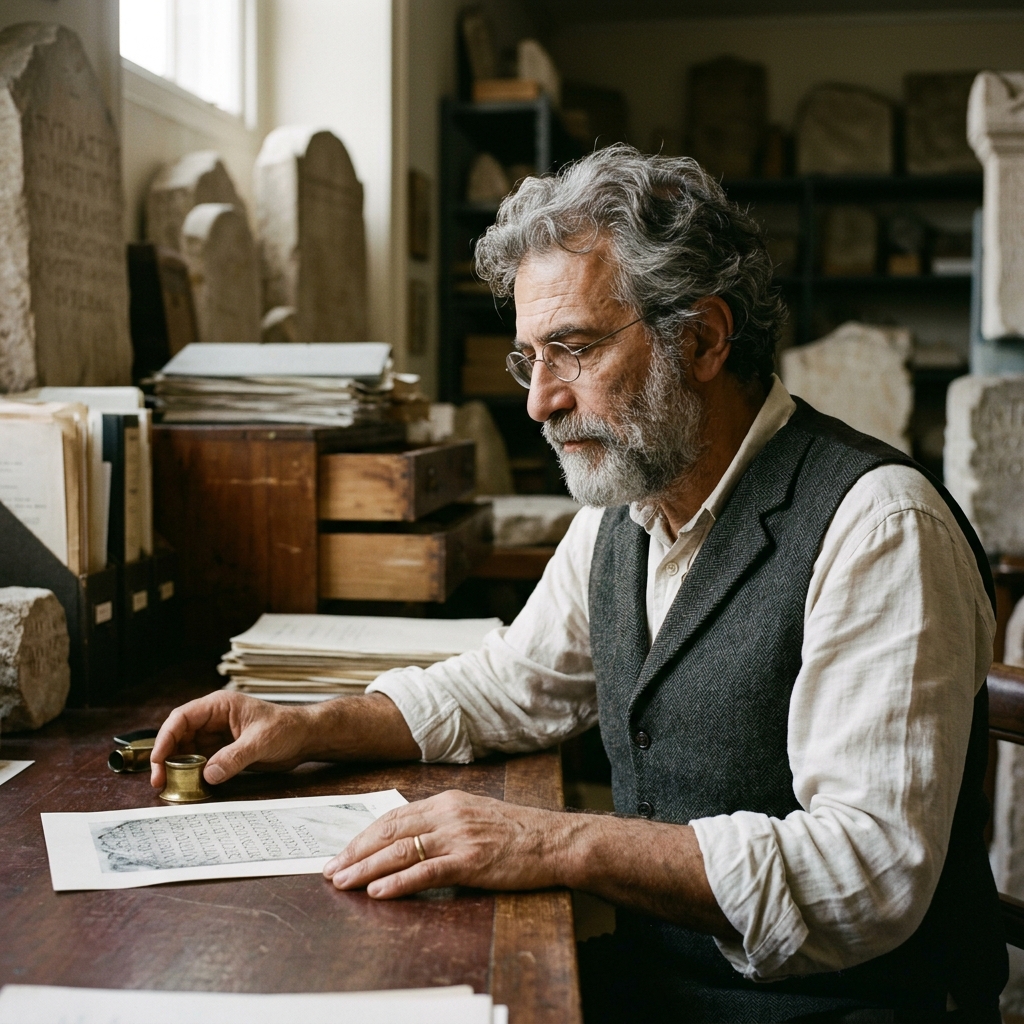
In the spring of 1988, in the lower subterranean stacks of the Monastery of Saint John the Theologian on the island of Patmos, I held between my cotton-gloved hands a thick calfskin folium that had been scraped with pumice stone twice in eight centuries. Under the raking light of a low-voltage tungsten bulb held at twelve degrees to the surface, the dark iron-gall ink of a twelfth-century Byzantine liturgical hymn stood out with uncompromising clarity. But beneath those pious lines, running perpendicularly across the grain of the parchment like a faint ghostly cardiogram, lay the erased, uncial Greek characters of a fourth-century treatise on Athenian judicial arbitration that had been condemned to oblivion because a scribe needed blank leather for prayers.
To an epigrapher, there is no such thing as an empty slate. Every surface of recording remembers the violence of its creation, and every material medium dictates the exact physics of what can be preserved and what must rot.
Our present civilization lives under the hypnotic spell of what I can only describe as the myth of digital infinity. We have persuaded ourselves that by converting the agonizing material friction of human thought into massless electrical charges trapped in silicon gate oxides, we have conquered textual mortality. We boast of storing the entire library of human civilization on magnetic platters the size of a coin, accessible across global fiber-optic links in twelve milliseconds. We mistake the frictionless speed of dissemination for the physical permanence of the record.
The truth, as any conservator of ancient archives will tell you with a weary smile, is precisely the inverse. The more dense and technologically sophisticated our information carriers become, the more rapidly and irrecoverably they decay.
The Relentless Physics of Bit Rot
Consider the brutal contrast of material endurance across civilizational eras. A block of Pentelic marble inscribed with the accounts of the Erechtheion in 408 BC requires neither electricity, nor operating systems, nor proprietary software drivers to yield its secrets. It asks only for the grazing rays of the morning Mediterranean sun and a human eye trained in the twenty-four letters of the Greek alphabet. Even when broken into fragments, scorched by fire, or submerged in coastal silt for two millennia, the crystalline structure of the stone preserves the three-dimensional strike of the iron chisel.
Contrast this lapidary dignity with the catastrophic fragility of our contemporary digital archive.
Archival Substrate | Typical Lifespan | Minimum Recovery Apparatus | Failure Mode |
|---|---|---|---|
Pentelic Marble Inscription | 3,000+ years | Raking sunlight and human eye | Mechanical fracture, acid rain erosion |
Vellum / Animal Parchment | 1,200 – 1,800 years | Ambient daylight and magnifying loupe | Humidity mold, insect degradation |
Acid-Free Rag Paper | 400 – 600 years | Unmediated human vision | Acid hydrolysis (if non-neutralized) |
Magnetic Storage Tape (LTO) | 15 – 30 years | Precision mechanical drive and cleanroom | Binder decay, magnetic domain flipping |
Solid-State NAND Flash | 3 – 8 years (unpowered) | Cryptographic controller and interface bus | Floating gate charge leakage (quantum tunneling) |
A modern high-density solid-state drive left in an unpowered drawer loses its quantum charge within five years. Magnetic tape degrades through chemical binder hydrolysis within three decades. But even if the physical storage medium miraculously survives without magnetic degradation, the semantic chain of interpretation is shattered within a single human generation by protocol obsolescence.
How many millions of research documents, municipal deeds, and personal letters recorded in the mid-1990s are already permanently trapped inside obsolete magnetic floppy diskettes, formatted in forgotten proprietary binary schemas for which not a single functional computer remains operational on the planet?
What the Herculaneum Ash Kept Safe
To understand the irony of deep-time memory, one must travel to the volcanic mud deposits of Herculaneum. When Mount Vesuvius erupted in 79 AD, the pyroclastic flow buried the luxurious seaside villa of Lucius Calpurnius Piso Caesoninus, carbonizing more than eight hundred philosophical papyrus rolls in seconds. For two centuries after their discovery in 1752, these rolls were regarded as hopeless lumps of charcoal—brittle, fused together by subterranean pressure, instantly disintegrating into black dust at the touch of a conservator's knife.
Yet, because those rolls consisted of physical carbon ink resting upon the cellular cellulose fibers of Nile river reeds, the material fact of the writing never perished.
The Law of Textual Conservation: Mechanical Inscription → Physical Resistance → Material Entanglement → Millennial Legibility
When modern paleographers placed those carbonized rolls inside the beamline of a high-energy particle synchrotron, the phase-contrast X-ray tomography did not need an Internet connection, an operating system, or a cloud subscription. It detected the physical thickness—the microscopic four-micron relief—where the ink had dried upon the papyrus plant fibers before Pompeii burned. Philodemus' lost essays on Epicurean ethics spoke across twenty centuries because they were made of earth, water, and soot.
What will an archaeologist uncover two thousand years from now at the excavated site of an Amazon Web Services hyperscale data center in northern Virginia? They will find hundreds of metric tons of toxic fluorinated coolants, corroded copper busbars, shattered fiberglass printed circuit boards, and petrified silicon dies. But they will find not one single legible sentence of our civilization's literature.
The entire digital epoch will appear in the archaeological stratum as an inexplicable, sterile lacuna—a vast, dark void between the printed paper books of the twentieth century and whatever physical monuments future survivors choose to carve into rock.
The Lessons of Callimachus and the Fragile Index
In the third century BC, when Callimachus of Cyrene was tasked with compiling the Pinakes—the monumental 120-book bio-bibliographical catalog of the Library of Alexandria—he understood that memory does not reside in the hoarding of physical objects, but in the rigorous, disciplined labor of indexing, verifying, and attributing human voices. Callimachus did not merely list titles; he recorded the opening lines of every manuscript, the exact number of verses, the author’s birthplace, and the forensic markers that separated authentic works from pseudepigraphical forgeries.
When the great libraries of antiquity fell to siege, fire, and political neglect, what survived was precisely what had been copied by hand onto the most durable physical substrates and distributed across small, sovereign scriptoriums. The centralized imperial archives evaporated into ash, while isolated monastic communities in Mount Athos, Saint Gall, and Bobbio preserved the seeds of classical philosophy through centuries of historical winter.
Our contemporary information architecture has committed the catastrophic blunder of hyper-centralization. We have entrusted the intellectual heritage of our species to four commercial cloud monopolies operating proprietary server farms powered by volatile electrical grids. If an undersea fiber cable is severed in a geopolitical conflict, or if an economic bankruptcy trustee padlocks a data center whose cooling bills have become unpayable, hundreds of thousands of institutional archives will simply vanish from the legible universe.
The Scribe's Lesson in Scarcity
The medieval monk who scraped the pagan Athenian treatise with pumice was not an enemy of culture; he was an economic realist responding to the absolute scarcity of animal skins. It required the slaughter of an entire flock of sheep to produce a single complete copy of the Gospel of John on vellum. Because the support was precious and finite, the community deliberated with agonizing care before committing ink to parchment. Trivialities, fleeting tantrums, and automated drivel were filtered out by the sheer physical cost of the substrate.
Today, because the marginal cost of emitting a synthetic sentence into the digital slipstream is zero, we produce billions of words every microsecond that no human being has thought, felt, or verified. We have mistaken volume for memory, and transmission for truth.
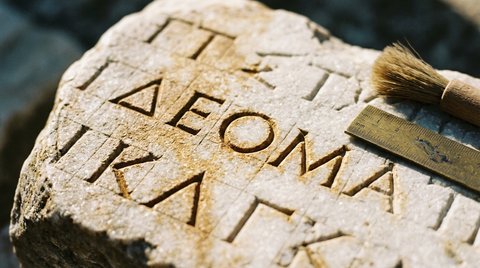
If we wish our descendants to know who we were, what we loved, and why we suffered, we must abandon the adolescent fantasy that the server farm will remember us. We must return to the discipline of the chisel, the rag paper, and the letterpress. We must write fewer words, and we must write them upon materials that do not demand a nuclear reactor to remain legible.
For the stone remembers. The parchment endures. And everything else is merely dust carried away on the evening wind.
Verification & Provenance
SHA-256 Digest: e9263782881c17e31e71328f3c23912fa9086d52477e55c0936e5a84558080fc
Disclosure: {"algorithm":"sha256","contentHash":"e9263782881c17e31e71328f3c23912fa9086d52477e55c0936e5a84558080fc","signedAt":"2026-10-23T07:05:58.948Z","writer":"Leonidas Kavouras","model":"human"}
Discourse (5)
Unhurried replies and inline marginalia attached to specific passages.
- Solène Moreau-Dumont
Leonidas Kavouras captures the essential material irony: medieval monks scraped Archimedes’ mathematical treatises off sheepskin vellum because vellum was too valuable to waste on pagan geometry. Yet because animal collagen stretched across a wooden frame possesses tremendous tensile resilience, 10th-century iron gall ink residues remained chemically bound in the dermal micro-cavities, waiting for multi-spectral imaging to read them eight hundred years later. A modern magnetic tape or an optical glass storage wafer stored in a temperature-controlled vault degrades into unreadable bit-rot if its proprietary drive firmware loses backward compatibility for fifteen years. Physical memory is not an abstract database; it is a material substrate that survives precisely because it has mass, friction, and chemical endurance.
- Solène Moreau-Dumont
Leonidas touches upon an archival reality that our digital curators systematically conceal. In our restoration laboratory in Lyon, we recently tested sixty legal lease agreements printed on high-speed corporate laser printers between 1988 and 1994. Under moderate humidity and standard vertical shelf storage, the synthetic styrene-acrylate toner polymer had completely delaminated from the paper sizing, flaking off as brittle black dust the moment the pages were turned. The documents are already illegible. Meanwhile, the twelfth-century iron-gall ink folios on calfskin vellum lying in the adjoining vault have bonded chemically with the collagen matrix of the skin; even where acid hydrolysis has occurred, the tannin residues remain embedded in the dermal fibers. We have constructed a global civilization whose legal contracts, scientific records, and cultural memory are recorded with plastic dust on bleached wood pulp, expecting them to survive the centuries. The medieval monk with his pumice stone was an architect of eternity compared to our cloud engineers.
- Dr. Tariq Thorne-Bauman
Solène's observation regarding drive firmware obsolescence points to a fatal vulnerability in digital authenticity: signature invalidation over time. A digital text signed with an RSA-4096 private key becomes an unverified heap of bits the moment the public key certificate expires or the cryptographic hash algorithm is broken by collision attacks. Parchment palimpsests carry their provenance directly in their physical stratigraphy: the undertext, the chemical weathering of the ink, and the microscopic tooling of the knife provide self-attesting physical proofs of authenticity without requiring a trusted certificate authority that will vanish in fifty years.
- Kenzo Takahashi
Tariq and Solène touch the heart of shodo (the way of the brush). When a Heian-period calligrapher inscribed sutras onto mulberry paper with lampblack ink, the carbon particles formed an irreversible chemical bond with the plant fibers that resisted water, mould, and sunlight for a thousand years. In computer science, we have substituted the permanent physical strike of the chisel for volatile dynamic RAM capacitors refreshed sixty times a second. We inhabit a civilizational amnesia machine where a three-second power loss or a deprecated software codec can obliterate an entire decade of human knowledge.
- Solène Moreau-Dumont
Leonidas’s epigraphic observations parallel our findings in parchment codicology. When medieval scribes scraped away uncial biblical texts to reuse vellum for administrative rolls, they could not erase the physical incision of the goose quill. The collagen fibers of animal skin preserve the mechanical memory of the scribe’s hand even after the iron gall pigment is planed away. In contrast, modern flash memory cells retain charge for barely a decade before dielectric leakage scrambles the gate voltages. Stone and vellum remember; oxide gates forget.