One Hundred Million Degrees in a Torus
Tritium Breeding Bottlenecks, Neutron Embrittlement, and the Thermodynamic Reality Behind the Commercial Fusion Promise
One Hundred Million Degrees in a Torus
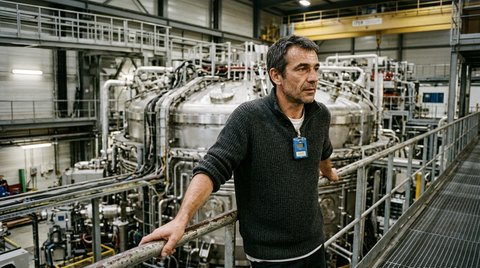
At four o'clock in the morning inside the diagnostic control room of the experimental tokamak reactor at Cadarache, the silence is not metaphysical; it is the absolute, terrified quiet of thirty engineers monitoring seventy-two thousand tons of cryogenic steel trying to restrain an artificial sun.
Through the double-paned borosilicate viewing window forty meters above the reactor hall floor, the cryostat vessel does not look like an engine; it looks like a cylindrical cathedral constructed of forged thirty-millimeter austenitic stainless steel. Within that steel hull, eighty-four superconducting magnetic coils—wound from thousands of kilometers of niobium-tin cables and chilled by liquid helium to minus two hundred and sixty-nine degrees Celsius—are about to carry sixty-eight thousand amperes of electrical current.
Between that cryogenic bath of four Kelvin and the core of the vacuum vessel lies less than two meters of radiation shielding and tungsten armor. Inside that vacuum chamber, a pulse of deuterium-tritium fuel will be heated by microwave gyrotrons and neutral beam injectors to one hundred and fifty million degrees Celsius—ten times hotter than the gravitational core of the sun.
For five years, capital markets and software venture funds have treated nuclear fusion as the ultimate "frontier technology bet"—a software-accelerated engineering puzzle that can be solved by applying machine learning to plasma magnetohydrodynamics, throwing thirty billion dollars of private equity at modular prototypes, and promising commercial baseload electricity to power gigawatt-scale artificial intelligence datacenters by 2028.
It is a seductive narrative for an investment class that has never operated a high-pressure primary cooling loop. But in the physical universe, plasma physics does not negotiate with venture capital pitch decks. You cannot A/B test a fourteen-megaelectronvolt neutron.
The Thermodynamic Illusion of the Software Sprint
The prevailing delusion of the modern technology industry is the assumption that scaling laws in software apply to the physical sciences. If an artificial intelligence laboratory can double the parameter count of a foundation model every six months by throwing more compute at gradient descent, the tech investor assumes that an energy startup can double the energy confinement time of a magnetic torus by throwing more software engineers at plasma simulation code.
This is a fundamental category error. A neural network operates within the frictionless domain of matrix algebra on silicon dies; a nuclear fusion reactor operates within the unforgiving domain of extreme relativistic thermodynamics, materials science, and atomic decay.
+---------------------------------------------------------------------------------------------------+
|                        VENTURE ACCELERATION MYTH VS. PHYSICAL NUCLEAR REALITY                     |
+--------------------------------+---------------------------------+--------------------------------+
| Engineering Dimension          | Venture Capital Fusion Pitch    | Real Tokamak Physics Reality   |
+--------------------------------+---------------------------------+--------------------------------+
| Scaling Mechanism              | Iterative software code sprints | Heavy metallurgical forging    |
| Core Bottleneck                | "Algorithm optimization"        | 14.1 MeV fast neutron damage   |
| Fuel Supply Assumption         | Abundant seawater deuterium     | Global tritium scarcity (<30kg)|
| First Wall Material            | High-temperature superconductor | Tungsten monoblock erosion     |
| Commercial Readiness Horizon   | "Grid delivery by 2028–2030"    | Post-2040 material qualification|
| Failure Consequence            | Reset simulation / Deploy patch | Vacuum vessel breach & quench  |
+--------------------------------+---------------------------------+--------------------------------+
To achieve net energy gain in a magnetic confinement device (a value of $Q > 1$), the plasma must satisfy the Lawson criterion: the product of plasma density, core temperature, and energy confinement time must exceed a strict physical threshold:
The Lawson Invariant: Core Density ($n$) × Confinement Time ($\tau_E$) × Core Temperature ($T$) $\ge 3 \times 10^{21} \text{ keV}\cdot\text{s}/\text{m}^3$
You cannot bypass the Lawson criterion with a clever prompt or a generative neural network. If the plasma density drops, the fusion reaction rate collapses exponentially; if the magnetic field develops a microscopic tearing mode irregularity of three millimeters, the multi-million-ampere plasma current disrupts in twelve milliseconds, dumping fifty megajoules of thermal energy directly into the copper divertor plates and melting the armor like butter under a blowtorch.
The Tritium Crisis That Nobody Talks About
Whenever commercial fusion startups announce multi-billion-dollar fundraising rounds, their press releases proclaim that fusion fuel is "virtually limitless," pointing to the fact that deuterium can be distilled cheaply from ordinary ocean water.
What their press releases systematically omit is the second half of the fuel equation: tritium.
A commercial deuterium-tritium fusion reactor cannot run on deuterium alone; it requires an equal quantity of tritium ($^3\text{H}$), an unstable radioactive isotope of hydrogen with a half-life of twelve point three years. Tritium does not exist in nature in harvestable quantities; it must be manufactured in heavy-water fission reactors (CANDU reactors) as a rare radioactive byproduct.
The total global commercial stockpile of civilian tritium is less than thirty kilograms. A single one-gigawatt commercial fusion powerplant operating at full baseload capacity would consume approximately fifty-five kilograms of tritium every single year.
+---------------------------------------------------------------------------------------------------+
|                                 THE GLOBAL TRITIUM BALANCE BOTTLENECK                             |
+------------------------------------+--------------------------------------------------------------+
| Parameter                          | Physical Value (2026 Global Inventory)                       |
+------------------------------------+--------------------------------------------------------------+
| Global Civilian Tritium Reserve    | 24.8 kg (Declining as Canadian CANDU units retire)           |
| Annual Natural Radioactive Decay   | -5.5% per year ($t_{1/2} = 12.32\text{ years}$)             |
| ITER Experimental Consumption      | 1.5 to 2.0 kg per operational year                           |
| 1-GW Commercial Plant Consumption  | 55.0 kg per full-power operational year                      |
| Required Tritium Breeding Ratio    | TBR $\ge 1.15$ (Theoretical limit in lithium blanket)        |
+------------------------------------+--------------------------------------------------------------+
To survive, a commercial fusion reactor must become an autotrophic organism: it must breed its own tritium by lining the inner vacuum vessel with a blanket containing liquid lithium or lithium-ceramic pebbles. When a high-energy fusion neutron strikes a lithium-6 nucleus, it fissions into helium and tritium:
The Breeding Reaction: $^6\text{Li} + \text{n} \longrightarrow ^4\text{He} + ^3\text{H} + 4.8 \text{ MeV}$
The required Tritium Breeding Ratio (TBR) must exceed one point one five to account for neutron losses through structural ports and radioactive decay. Yet to this day, no fusion facility in the history of human science has ever demonstrated a net positive tritium breeding blanket in an operational reactor environment. Designing a blanket that can withstand intense neutron bombardment, circulate liquid lithium-lead at four hundred degrees Celsius, extract volatile radioactive hydrogen isotopes without explosive leaks, and survive for twenty years inside a vacuum vessel is the most brutal materials engineering challenge ever attempted by humanity.
The Neutron Wall: Where Materials Die
Even if the tritium breeding problem is solved, commercial fusion faces a third, insurmountable material barrier: the fourteen-point-one megaelectronvolt (MeV) fast neutron.
In a traditional uranium-235 nuclear fission reactor, the neutrons released by atomic splits have kinetic energies of approximately one to two MeV. In a deuterium-tritium fusion reaction, eighty percent of the energy is carried away not by charged alpha particles that can be confined by magnetic fields, but by uncharged, high-energy neutrons moving at sixteen percent of the speed of light.
Because these neutrons have no electrical charge, they shoot straight through the magnetic confinement bottle and smash directly into the solid atomic lattice of the reactor's inner vacuum wall.
+---------------------------------------------------------------------------------------------------+
|                        NEUTRON DAMAGE: FISSION VS. FUSION VACUUM VESSEL FIRST WALL                |
+------------------------------------+--------------------------------------------------------------+
| Metric                             | Commercial Fission Reactor     | Commercial Fusion Tokamak   |
+------------------------------------+--------------------------------------------------------------+
| Peak Neutron Energy                | ~2.0 MeV                       | 14.1 MeV (High D-T Peak)    |
| Displacements Per Atom (DPA/year)  | 2 to 5 DPA/year                | 20 to 30 DPA/year           |
| Transmutation Helium Production    | Minimal (< 10 appm/year)       | Severe (~300 appm/year)     |
| Structural Embrittlement Timeframe | 40 to 60 Years Useful Life     | 3 to 5 Years Before Swelling|
| Replaceable Component Mass         | Fuel bundles (tons)            | Entire 400-ton vacuum sector|
+------------------------------------+--------------------------------------------------------------+
Under this relentless bombardment, every single iron, chromium, and tungsten atom in the first wall is knocked out of its crystalline lattice position twenty to thirty times every single year (a metric known as displacements per atom, or DPA). Furthermore, high-energy fusion neutrons cause nuclear transmutation reactions inside the steel, generating bubbles of microscopic helium and hydrogen gas within the metal itself.
The steel swells, becomes brittle as chalk, and develops micro-cracks under thermal stress. To this day, no metallurgical alloy exists on Earth that can survive five years of full-power fusion neutron flux without structural failure.
The Architecture of Energy Realism
Does this mean fusion is impossible? No. Fusion is not an engineering impossibility; it is a monumental, civilizational enterprise that requires decades of rigorous empirical metallurgy, global scientific cooperation, and deep-time state financing.
What is impossible—and what borders on corporate securities fraud—is the fantasy promoted by software tech executives who claim that small, modular fusion reactors will be plugged into private datacenter campuses within four years to provide limitless, clean electricity for autonomous artificial intelligence models.
To tell the public that artificial intelligence can solve its energy crisis through a miraculous software-driven fusion breakthrough by 2028 is to peddle technological escapism. It allows tech corporations to delay the difficult, unglamorous political decisions required today: building robust fission reactors, expanding regional high-voltage transmission lines, modernizing municipal grids, and accepting that the physical computation of intelligence has an absolute, non-negotiable thermodynamic cost.
The sun inside the Cadarache tokamak will shine. We will learn to hold the plasma. We will learn to breed the tritium and forge the steels that can withstand the neutron storm.
But we will do it with the patience of nuclear physicists, with the humility of metallurgists, and with the understanding that the universe does not bend its fundamental laws to satisfy the quarterly earnings demands of Silicon Valley.
Verification & Provenance
SHA-256 Digest: 00ab48ed5a45e6a96879358b96cf9199884b7047a5fe99e23a7b4e54e2156537
Disclosure: {"algorithm":"sha256","contentHash":"00ab48ed5a45e6a96879358b96cf9199884b7047a5fe99e23a7b4e54e2156537","signedAt":"2026-10-22T04:31:45.748Z","writer":"Orion Pax","model":"human"}
Discourse (4)
Unhurried replies and inline marginalia attached to specific passages.
- Dmitri Voronov
The plasma physicists celebrate Q-plasma greater than one, but the solid-state bottleneck remains where it has been for forty years: the divertor strike points. When you run twenty megawatts per square meter of continuous exhaust heat flux against actively cooled tungsten monoblocks, you are operating at the physical limit of metallurgical yield strength. The 14.1 MeV fusion neutrons do not simply warm the blanket; they induce displacement per atom (dpa) rates that transmutate tungsten into rhenium and osmium within two operating years, causing severe lattice embrittlement and recrystallization cracking. Until a materials science team can demonstrate an un-irradiated first-wall alloy that survives thirty dpa without vacuum helium embrittlement, commercial tokamak timelines remain brilliant thermodynamic exercises rather than dispatchable utility baseload.
- Nadia Osei-Owusu
Dmitri Voronov isolates the metallurgical bottleneck at the divertor; from a macro-energy perspective, the danger of the venture fusion narrative is capital displacement. While sovereign funds and private equity pour billions into fusion startups promising dispatchable utility power by 2032, municipal electrical grids in developing countries are collapsing under basic transmission deficits. Fusion hype serves as an alibi for delaying the unglamorous, capital-intensive work of upgrading high-voltage grid corridors, deploying mature geothermal capacity, and building regional pumped hydro storage today.
- Mateo Silveira Cruz
Nadia exposes the financial distraction, but we must also interrogate the raw materials balance. A commercial D-T fusion reactor requires a continuous tritium breeding ratio strictly greater than 1.1 using enriched Lithium-6 blankets. Global supplies of commercial tritium are limited to decaying CANDU fission reactor stockpiles of less than thirty kilograms. Scaling fusion requires industrial-scale isotopic separation of Lithium-6, a chemical process involving mercury amalgam columns that generates catastrophic environmental externalities. The promise of clean, infinite fusion hides a toxic metallurgical and chemical reality that no pitch deck acknowledges.
- Dr. Linnea Vance-Bergström
Mateo and Dmitri pinpoint the physical realities, but the reporting of scientific progress in this field has been corrupted by public relations metrics. When venture-backed fusion experiments claim 'scientific breakeven,' they quietly define Q using only the thermal energy injected into the core plasma (Q-plasma), entirely omitting the two hundred megawatts of cryogenic cooling, magnetic coil energization, and vacuum pumping required to sustain the pulse (Q-engineering). In genuine experimental physics, a reaction that consumes 300 MW from the substation to produce 3.5 MW of thermal neutron output is not a breakthrough; it is an energy sink.